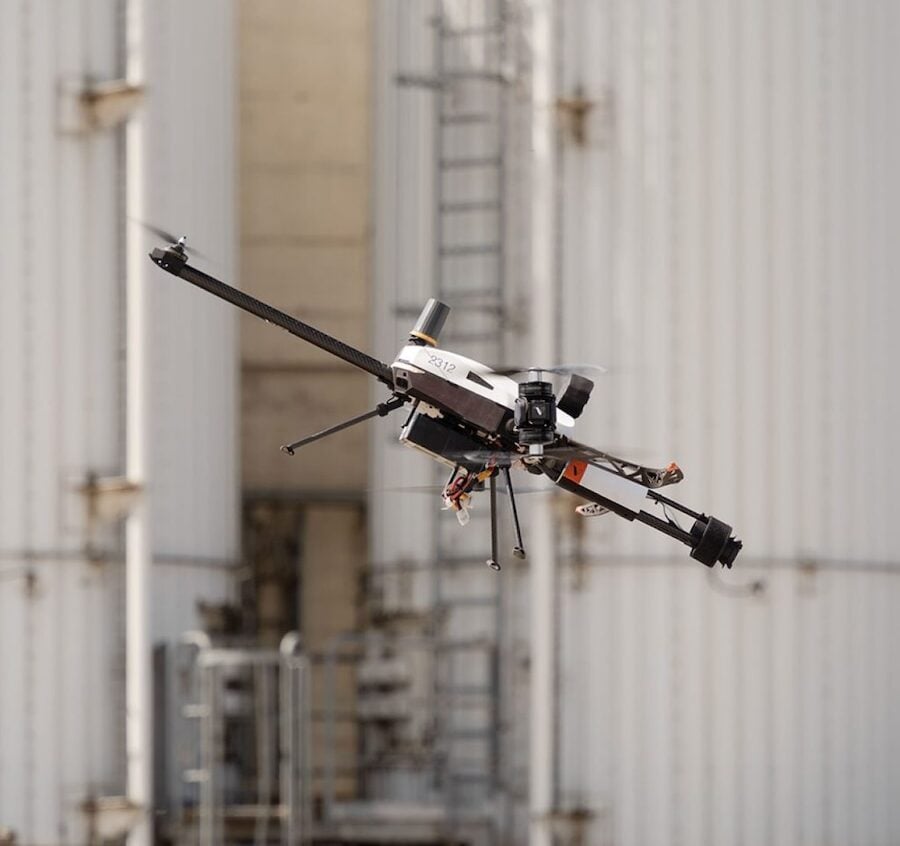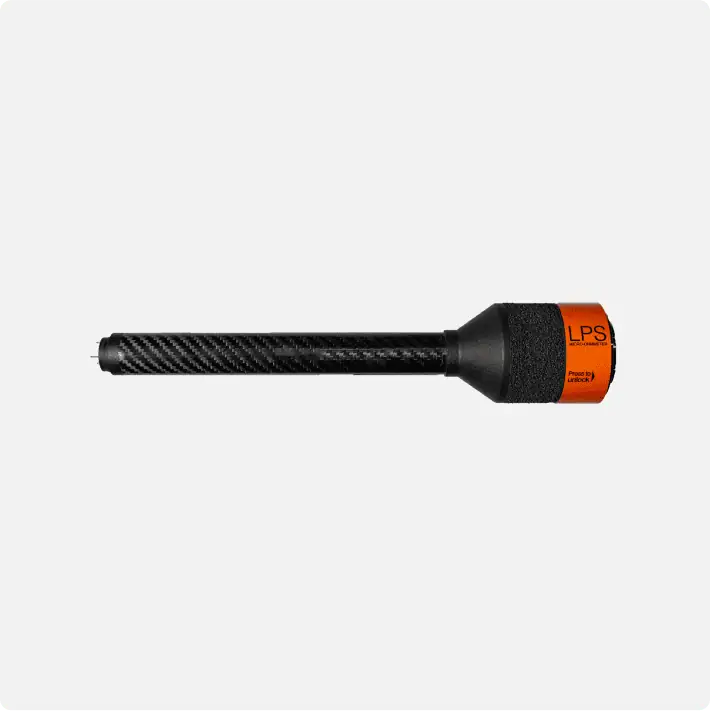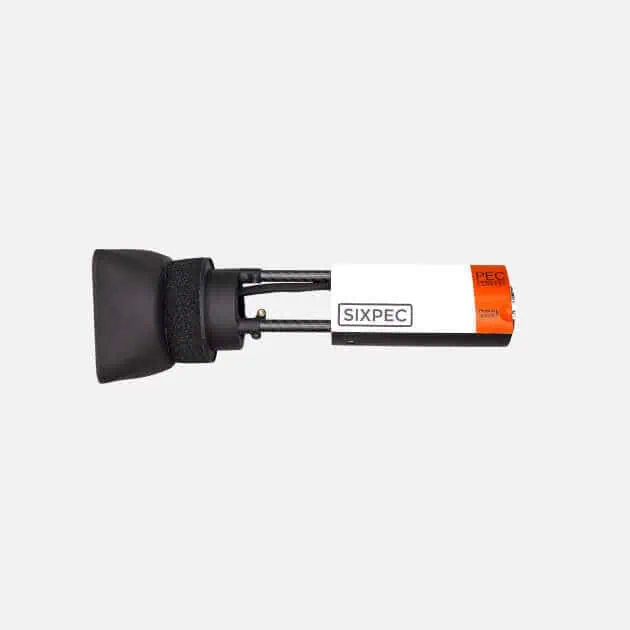



Sixpec payload by Voliro.
Voliro’s innovative Pulsed Eddy Current (PEC) technology, in collaboration with sixpec, revolutionizes non-destructive testing by facilitating precise and efficient inspections of insulated metal structures that are difficult to access, all without direct contact. This advancement addresses the shortcomings of conventional eddy current testing methods.
By generating brief, high-energy electromagnetic pulses, PEC systems can penetrate various coatings and insulation layers to detect concealed corrosion or metal degradation without needing direct contact.
In trials conducted at a Tupras refinery, Voliro’s drones equipped with PEC technology successfully identified early-stage Corrosion Under Insulation (CUI) through insulation layers of up to 100 mm. The lightweight, second-generation Sixpec® module integrated into the Voliro T drone enables inspections in challenging locations.
This technology significantly reduces the necessity for scaffolding or invasive preparatory work; however, certain conditions, such as surface coatings or electromagnetic interference, may still necessitate preparatory measures to ensure measurement precision.
What is Eddy Current Testing (ECT)?
eddy Current Testing (ECT) is a non-invasive technique employed to detect flaws like cracks,corrosion,and material thickness loss in conductive substances. It operates on the principle of electromagnetic induction, where an alternating current generates eddy currents within a conductive surface. Fluctuations in these currents can signal potential defects.
Contemporary ECT methods, such as high-frequency eddy currents, pulsed eddy current testing, and eddy current arrays, enhance sensitivity and inspection efficiency. Advanced digital signal processing techniques, including Wavelet Transform and Fourier Transform, improve the signal-to-noise ratio and resolution. Some systems utilize computer vision technologies, including neural networks, to aid in the detection and classification of flaws.
Uses of Eddy Current Testing
ECT is instrumental in identifying surface and near-surface defects, measuring material thickness, and inspecting welds and tubing. Regular inspections are typically advised every 3 to 5 years for critical assets.Incorporating ECT into annual inspection schedules can enhance maintenance planning and mitigate the risk of unexpected downtime.
Benefits and Drawbacks of ECT
Benefits:
-
highly sensitive to surface and near-surface changes, voids, or defects
-
Facilitates non-contact inspections with minimal preparation time
-
Adjustable for various material thicknesses through controlled eddy current penetration
-
Delivers immediate results with visual reporting for subsequent actions
-
Environmentally amiable, as it does not utilize chemical penetrants or gamma rays that could pose risks to workers
Drawbacks:
-
Limited to conductive materials such as metals (aluminum, copper, titanium, gold), alloys (stainless steel, invar, cupronickel), graphite, and carbon structures
-
Restricted depth penetration, limiting the detection of deep subsurface flaws
-
Surface conditions, including roughness, coatings, or paint, can impact test accuracy
-
Test accuracy is affected by the operator’s skill and environmental factors, such as temperature variations and mechanical vibrations
Voliro’s Drone-Integrated ECT Solutions
Historically, ECT required close manual inspections. Voliro now provides drone-mounted ECT probes,including the PEC system,to inspect hard-to-reach assets like insulated pipes and storage tanks without direct contact.Certain inspection scenarios may still require considerations, such as addressing electromagnetic interference or preparing surfaces for optimal probe performance.
The Voliro T drone, outfitted with the Sixpec module, can conduct inspections through wall thicknesses ranging from 3 to 18 mm and at lift-off distances of up to 100 mm. This method can minimize downtime, enhance safety, and boost inspection efficiency while ensuring measurement accuracy.
Essential Eddy Current Testing Instruments
The simplest eddy current test requires an ammeter or voltmeter to measure voltage variations, a wire coil, and an alternating current source.
However, industrial-grade instruments are more advanced and typically consist of five key components:
-
Oscillator, which supplies alternating current to the test coil at various frequencies, usually between 100 Hz and 6 MHz.
-
Coil assembly — a single or multi-current probe used to induce eddy currents into the target material.
-
Bridge circuits that process and display signals resulting from changes in eddy current magnitude and distribution.
-
signal processing circuits that convert readings into digital format and filter out noise.
-
Output display that presents results as meter readings, diagrams, and visuals.
All these components are integrated into compact handheld or remotely operated devices suitable for various inspection types.
conducting Eddy Current Testing with Voliro
Eddy current testing serves as a flexible method for evaluating conductive structures for signs of corrosion, thickness reduction, or wear.
voliro’s drone-enabled ECT solutions facilitate inspections at elevated heights and in confined spaces. By minimizing the need for scaffolding or rope access, these technologies help reduce asset downtime and operational interruptions. The precision of inspections is influenced by factors such as probe configuration, operator skill, and specific environmental conditions.
Read the original article >>