
the Squads of Adaptive Robots (SoAR) initiative, a two-year collaborative research and development project, has successfully concluded, paving the way for advanced offshore operations.
As maritime tasks grow increasingly intricate and costly, coupled with the expansion of energy infrastructure further from shore, there is a pressing demand for enhanced multi-platform capabilities.
This innovative fleet of marine robots stems from a pioneering project led by Planet Ocean, the creators of ecoSUB AUVs, and supported by Innovate UK, with the goal of revolutionizing ocean exploration methodologies.
The primary objective of the soar team was to illustrate how extensive survey and exploration missions can be conducted by transcending the limitations of standalone autonomous underwater vehicles (AUVs). Successful open-water trials demonstrated coordinated missions that were designed, monitored, and adjusted in real-time by an intelligent “Autonomy Engine.”
Innovative Technology
The fleet-level autonomy engine,developed by Royal Holloway,University of london,functions as the mission’s central control system,making instantaneous decisions and reconfiguring plans as needed due to factors like mission inaccuracies,vehicle malfunctions,environmental changes,or the addition and removal of operational stations.
The SoAR Communications Backbone, created by the National Oceanography Center (NOC) team, addresses the lack of standardized interfaces and dialog protocols. It serves as a central messaging hub that facilitates interoperability between the fleet-level autonomy engine, each vehicle’s command and control system, and any other subsystem requiring two-way communication.
This capability is crucial for the seamless integration of various platforms and subsystems in diverse combinations to meet a wide array of mission objectives.
During the trials, Sonardyne provided inter-medium communications through its AvTrak 6 Nano acoustic transceivers installed on each AUV. This setup enabled simultaneous USBL tracking via a surface vessel and robust telemetry for AUV-to-vessel and AUV-to-AUV communications. More details about the trial can be found on the ecoSUB Robotics website.
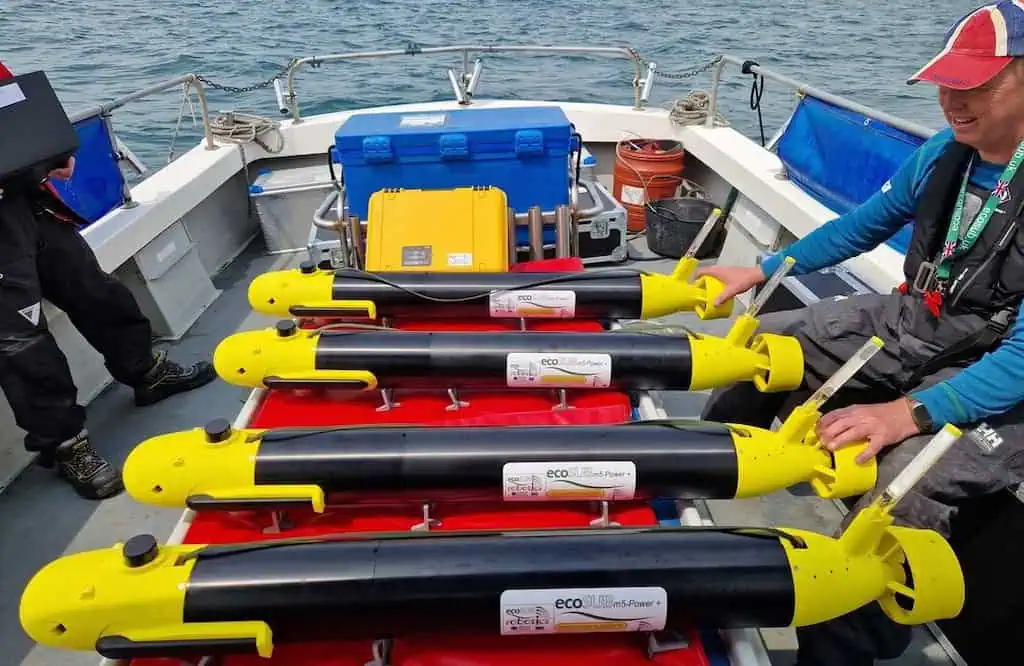
ecoSUB AUVs signify a major leap forward in cost-effective and adaptable ocean science robotics. These AUVs are equipped to deploy a variety of advanced sensors, including high-quality side-scan sonar systems, Doppler Velocity Logs (DVL), acoustic communication tools, and various scientific payloads, making them suitable for multiple sectors and applications.
A small swarm of four ecoSUB AUVs, each equipped with a Sonardyne AvTrak 6 Nano acoustic transceiver, played a vital role in swiftly assessing the underwater environment and conducting preliminary evaluations to pinpoint areas of interest.
Auto-Hover 1 (AH1), owned and operated by NOC, represents the pinnacle of hover-capable AUV technology.With six thrusters, AH1 excels in maintaining precise positioning and navigating vertically within the water column.
Equipped with advanced sensing capabilities and an AvTrak transceiver, AH1 was dedicated to close inspection tasks, allowing for detailed and thorough examinations of identified targets.
HydroSurv’s innovative long-endurance Unmanned Surface Vehicle (USV), the REAV-60, was specifically designed for operations Beyond Visual line of Sight (BVLoS). Its versatility caters to a wide range of offshore survey and inspection requirements while complying with emerging regulatory standards.
Sonardyne’s REAV-60 USV, named ‘Decibel,’ played a crucial role as a communications hub for the AUV swarm. It was equipped with an HPT 3000 transceiver and operated using their established Ranger-2 software, facilitating inter-medium communication and navigation support for the AUVs.
Decibel also featured various communication systems, including 4G/LTE and Iridium satellite communications, to ensure connectivity between subsea, surface, and the Autonomy engine.
The SoAR fleet was managed and controlled from HydroSurv’s shore-based Remote Operations Centre in Exeter, utilizing 4G/LTE and Iridium communications.
funding for SoAR was provided through the ‘Next Generation Subsea Technologies’ competition, a collaborative effort supported by Innovate UK, the Net Zero Technology Centre, and the Royal Navy.
The SoAR concept is versatile and can be adapted for various applications,but it is indeed strategically designed to meet the specific demands of the offshore wind industry,offering new operational paradigms and critically important long-term cost savings for offshore asset construction and maintenance compared to conventional methods.
The project commenced in September 2021 and culminated this summer with comprehensive system testing at Smart Sound Plymouth on England’s southern coast.
Discover more about the trials on the ecoSUB Robotics website >>