

Wavefront Systems has published an insightful article highlighting the advantages of outfitting remotely operated or autonomous vehicles with its advanced Vigilant long-range 3D Forward Looking Sonar (FLS) to improve underwater situational awareness.
1 Overview
The Vigilant Forward Looking Sonar (FLS) system, crafted by Wavefront Systems Ltd in the UK and produced by its affiliate, Sonardyne International, stands as a premier navigation and obstacle detection sonar. It is engineered for deployment on conventional vessels, unmanned surface vehicles (USVs), and both crewed and uncrewed underwater vehicles. This system autonomously detects objects and obstacles that could jeopardize navigation, providing real-time positioning of hazards in the water column and generating a digital terrain map of the seabed, indicating safe navigation routes. The collected data can be integrated into third-party command and control systems or visualized through our proprietary user interface.
Vigilant operates in two distinct modes. In DEPTH mode, it delivers precise 3D bathymetric imagery and color-coded depth visuals up to 600 meters away and down to 100 meters deep, covering a 120-degree field of view. In SONAR mode, it analyzes acoustic data to extract long-range positional facts up to 1.5 kilometers, maintaining the same 120-degree field of view.The sonar returns trigger alerts for navigational hazards.
wavefront Systems has successfully integrated the Vigilant FLS across various platforms, including luxury yachts, military submarines, and unmanned underwater vehicles (UUVs). This article will focus on a specific installation case study,detailing the installation,integration,and configuration processes,while also sharing the outcomes.
In March 2021, the UK’s Defence and Security Accelerator (DASA) launched a competition for innovative sensors and payloads to be tested on an Extra-Large Uncrewed Underwater Vehicle (XLUUV). This initiative, a collaboration between the Royal Navy and the Defence Science and Technology Laboratory (DSTL), was conducted aboard the MSubs XLUUV test platform based in Plymouth, UK, and was sea-trialed in the waters south of Plymouth Sound.
2 Integration and testing
2.1 Integration onto the Test Platform
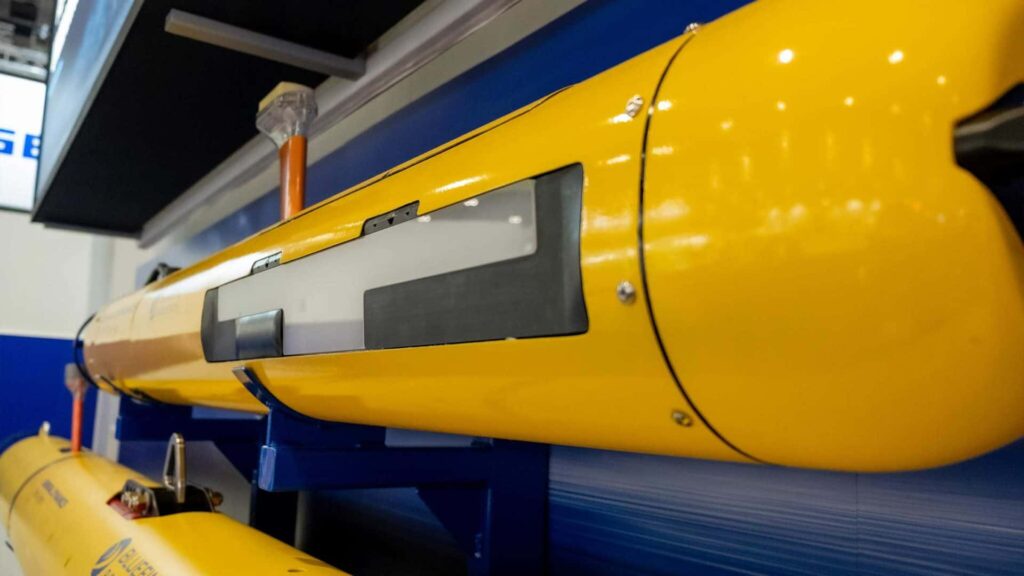
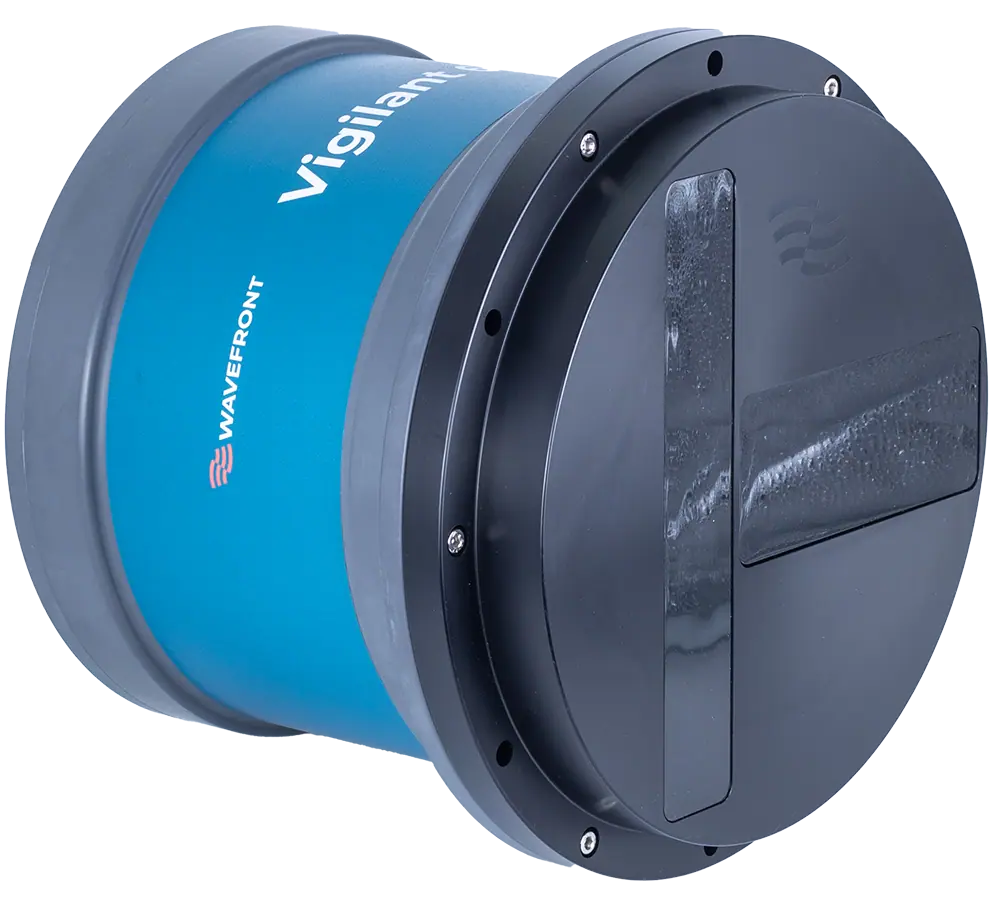
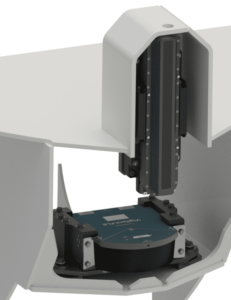
The Vigilant FLS features two in-water phased arrays: a projector array that emits frequency-encoded ultrasonic sound waves and a multi-element hydrophone receiver that electronically scans a 120° azimuth in front of the vehicle, capturing the returning signals.
A notable feature of the Vigilant FLS system is its capability to export sonar data to third-party software, enabling the integration of this data into other systems or direct input into command and control (C2) software for automatic course adjustments to avoid obstacles or threats.
To accurately determine its position and movement, the Vigilant system can interpret navigation data, requiring global positioning, heading, and, for submersible vehicles, dive depth. it can process various formats,from standard NMEA messages to proprietary protocols from specific sensors.
The MSubs platform was already equipped with Sonardyne International’s advanced combined inertial navigation sensor (INS) and Doppler velocity log (DVL) sensor, the Sprint-NAV 700, allowing us to receive the proprietary LNAV(UTC) message from the unit.
While the data can be overlaid onto an Electronic Navigational Chart (ENC or ECDIS), the system’s graphical user interface (GUI) can also be pre-loaded with standard or securely encrypted electronic charts (S57 or S63). This allows the system to automatically crop the acquired data to fit the ENC layers,significantly enhancing the user experience.
2.2 Sea Trials
The initial test of the Vigilant FLS on the MSubs XLUUV platform occurred 4.2 nautical miles south of Plymouth Breakwater in approximately 50 meters of water, in an area locally referred to as the ‘Spoiling Ground’.
the primary objective of this initial trial was to verify that the FLS system could accurately receive position, heading, pitch, roll, and depth data from the vehicle’s internal systems and successfully export the processed data to the designated location.
Once all parties confirmed that the navigation data was being accurately received and that the processed FLS data was being exported correctly, the team proceeded to the main trial area known as ‘Hand Deeps’.
Hand Deeps is a granite reef located 8 nautical miles southwest of Rame Head in plymouth Sound, just west-northwest of the renowned eddystone lighthouse. The seabed, composed of sand and broken shells, descends to 55 meters, with the outcrop rising to a depth of 9.5 meters.
3 Findings and Analysis
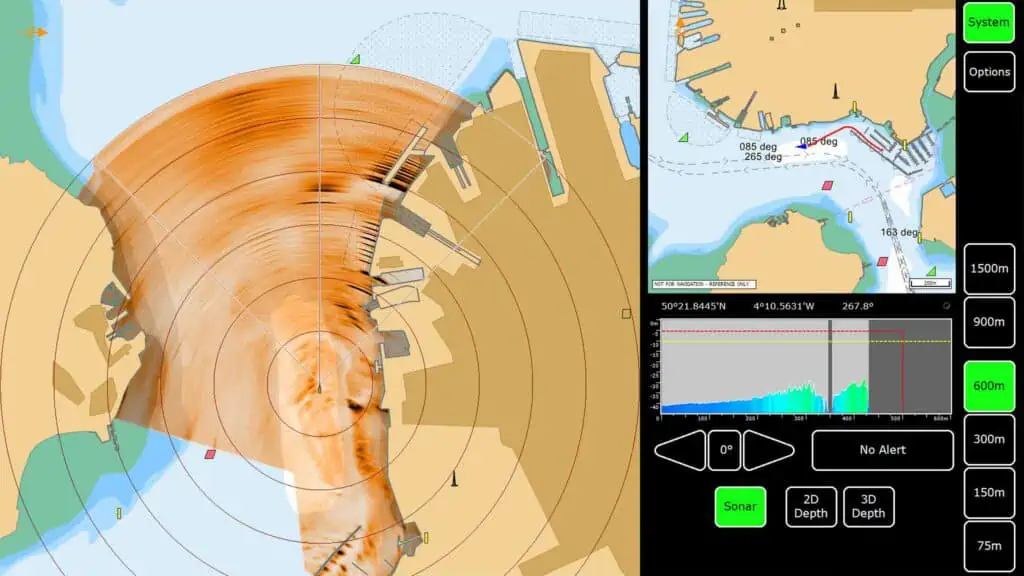
We consider the data produced by the system to be industry-leading,both in quality—ensured by our proprietary Altitude Confidence Filtering (ACF) algorithms—and in quantity,supported by our high-resolution physical array design,which allows for bathymetric imaging at distances up to 20 times the prevailing water depth ahead of the platform.

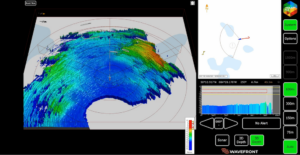
Real-time FLS imagery generated on-board MSubs by Vigilant during the sea trial in the ‘Hand Deeps’ area, near Plymouth, UK.
2D Depth mode (top); 3D Depth mode (bottom).
4 Insights Gained
This marks the third generation of FLS technology from Wavefront, reflecting nearly a decade of progress. Each iteration has built upon the lessons learned from previous designs.
The first generation, known as ‘NOAS – Navigation and Obstacle Avoidance Sonar,’ was primarily military-focused, relying on trained sonar operators to derive underwater situational awareness from the sensor data.
The second generation, NOAS 2, shifted its focus to the commercial sector, initiating the development of a more user-friendly, intuitive man-machine interface (MMI) designed for civilian applications, without requiring prior knowledge of real-time imaging sonar.
The third generation, ‘Vigilant,’ is the subject of this discussion. This sonar is more compact for easier installation, whether in new builds or retrofits, while delivering significantly enhanced sonar performance.The MMI has evolved to require minimal operator interaction, even allowing for full AI automation, alongside thorough updates to signal and data processing.
5 Future Developments
We are in the process of developing two new variants of the Vigilant family. The version discussed in this article is the Vigilant 1500, while the upcoming models will be named Vigilant 1000 and Vigilant 500. These new systems will be even more compact than the Vigilant 1500, enabling installation on a wider array of platforms.
Acknowledgments
Wavefront Systems Ltd extends its gratitude to MSubs Ltd and Submergence Group for providing data generated from the Vigilant systems utilized on their vehicle, and also to Sonardyne Plymouth for the use of their surface vessels during trials.
Author/Speaker Profiles
Andy Millar (MNI) possesses extensive experience in the maritime sector, having worked on commercial vessels and held senior positions in maritime service companies across Europe and the Americas. He joined Wavefront Systems in 2021 as the Head of Sales for their premier sonar systems.