

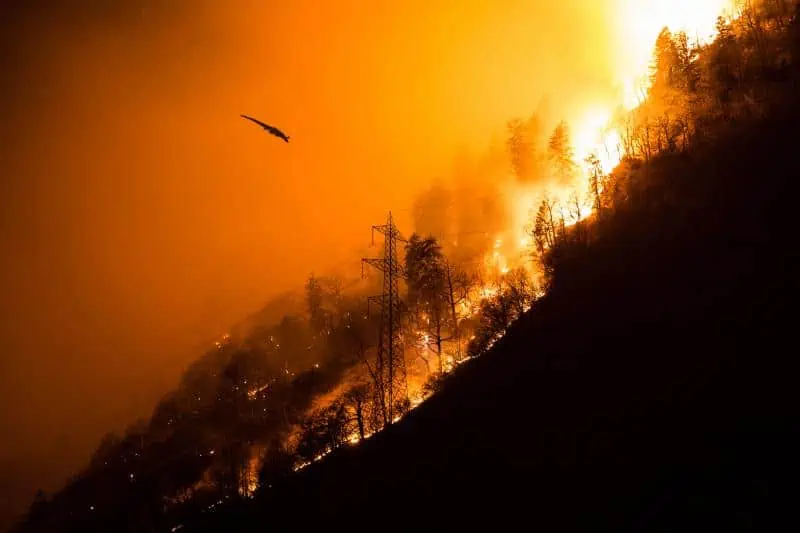
DeltaQuad explores the increasing frequency of wildfires globally and how drones can enhance the capabilities of firefighting teams in detecting, coordinating, and managing these blazes.
this article discusses:
- proactive wildfire detection
- Streamlined coordination and containment
- Enhancing safety for firefighting teams
- Refined monitoring and situational awareness
- Cost-effective wildfire management
- The impact of DeltaQuad Evo
DeltaQuad Evo is a dependable and adaptable platform that provides numerous benefits for wildfire detection and management. With a flight duration exceeding four hours and a flexible payload capacity, it can survey extensive areas and execute various missions, including capturing high-resolution images, thermal data, and other vital details necessary for effective wildfire detection and assessment.
Wildfires are becoming more frequent, lasting longer, and burning with increased intensity.This trend is evident across North and South America, Europe, and regions like Indonesia and Australia. The wildfire season is extending, with some areas facing nearly year-round threats. What measures can be taken to safeguard communities, protect lives, and conserve ecosystems?
For instance, Canada set a record by June 27, 2023, for the largest area affected by wildfires in a single year, and this was before the peak season had even begun. In Europe, the number of wildfires this year has already approached four times the average.
The United Nations Environment Program warns that the global situation is deteriorating rapidly, predicting a 14% rise in extreme fires by 2030, escalating to 30% by 2050.
In many regions, the primary causes of wildfires include lightning, human activity, and poorly maintained power lines. While human-caused fires are meaningful in populated areas,approximately 90% of the total area devastated by wildfires in boreal forests is attributed to lightning strikes.
Given this alarming scenario, what improvements can be made? Can drones offer advantages in firefighting? How can they assist in wildfire detection, assessment, and containment? We consulted wildfire experts globally to gain insights into the current challenges and opportunities for saving lives.
“Fire plays a crucial ecological and historical role in many Canadian ecosystems,” stated John Davies, a senior wildland fire specialist in British Columbia. “Our grasslands and forests have adapted to fire as a natural means of regeneration. Though, these large, destructive fires are not typical and can harm ecosystems. Wildfire patterns are shifting, which is concerning. We need to detect them early, respond quickly, and keep them small.By providing real-time, actionable information, we enhance the efficiency and safety of our operations.”
proactive Wildfire detection
The speed at which wildfires are detected and validated is crucial for successful outcomes. Arnoud buiting, a program director for operational readiness and fire department safety in the Netherlands, shared insights on current detection methods: “Surveillance in the Veluwe, a forested region, is conducted using aircraft, which are costly to operate and maintain. Recreational users frequently enough report wildfires via mobile networks, but the challenge lies in the inability to monitor everywhere concurrently. Additionally, verifying detected fire images and pinpointing exact locations are significant gaps in the current approach.”
In other areas, continuous camera networks are utilized across vast regions, employing AI to detect smoke and alert authorities. However, their coverage is limited. Satellite imagery is another detection method, but with a pass-over frequency of only once or twice daily, it can be less effective. By the time people, fixed cameras, or satellites identify smoke, the fire may have already taken hold.
Drones provide rapid aerial surveillance and real-time data, enhancing situational awareness and enabling quicker responses to wildfires, which improves detection and coordination among fire management teams.
An innovative example of drone technology in early wildfire detection is the Fire Neural Network™. In the Western US, lightning causes most of the area burned, yet only about 5% of lightning strikes are capable of igniting fires, termed High-Risk-Lightning™ (HRL) strikes.The Fire Neural Network™ has developed a system that promptly alerts when an HRL strike occurs. Detectors capture high-current lightning strikes,combined with local environmental and fuel characteristics. An AI algorithm processes this data to generate HRL alerts.Once a hazardous strike point is identified, a drone can verify the ignition location. This real-time information allows first responders to concentrate their resources on critical areas rather than patrolling vast regions without direction. This technology has been implemented in the US (Florida), the Australian capital Territory, and the Brazilian Amazon.
Streamlined Coordination and Containment
Detection is just one aspect of the initial challenge. Once a fire is identified, crews must be deployed to the correct location with as much situational awareness as possible, which can consume valuable time.
“When we know there’s lightning,we need to respond as soon as conditions permit,” explains Davies. “However, if a lightning storm occurs late in the evening or overnight, there may not be enough daylight to investigate an emerging fire until morning due to nighttime flight restrictions. Consequently,fires could burn for eight to ten hours before detection.”
“Conditions can change rapidly. Within an hour, a small spot fire can escalate into a large wildfire requiring helicopters, air tankers, and more ground crews than initially dispatched. Timing is critical. Utilizing drones to supplement or replace aircraft during a busy fire season could provide a significant advantage.”
Once a wildfire is detected, drones can serve as scouts, arriving ahead of first responders and allowing remote teams to assess the situation as it unfolds. Kihan Garcia, a mechanical engineer specializing in remotely piloted systems from Wollongong, Australia, emphasizes that drones should work alongside manned aircraft in wildfire response efforts. They can provide crucial situational awareness by capturing real-time data and relaying valuable information on optimal locations for aircraft to conduct water drops effectively.
By collaborating with manned aircraft, drones enhance the coordination and efficiency of aerial firefighting operations, enabling a more targeted and strategic approach to wildfire containment.
enhancing Safety for Firefighting Teams
When wildfires ignite, crews aim to extinguish them by 10 AM the next day, before humidity levels drop, which can exacerbate fire spread.However, this is not always feasible, and by afternoon, the fire can intensify, notably when influenced by wind, which plays a crucial role in wildfire propagation. Wind can rapidly spread flames,carrying embers ahead of the main fire and creating unpredictable fire behavior. In such a volatile environment, drones provide essential situational awareness, keeping firefighters informed and safe.
“It’s crucial to provide real-time intelligence to first responders,” states josh Wilkins, a seasoned fire officer and wildfire technology advisor in Hailey, idaho.“That’s our primary goal. everyone should be fully aware of their situation, which is a significant challenge when facing an unpredictable wildfire. We aim to save lives by minimizing risks, and that’s where drones can make a significant impact.”
Drones can also search for spot fires, scanning the fireline for embers ejected ahead of the main wildfire. This real-time data helps prevent crews from becoming trapped while also assessing safe zones during rapidly evolving situations.All this information feeds back into the Incident action Plan (IAP), forming the basis for developing flexible strategies and achieving objectives on a daily and hourly basis.
Sophisticated Monitoring and Situational Awareness
When a hotspot is smoldering on the ground and not producing much smoke, sometimes for days, a drone’s thermal imaging camera can be adjusted to detect the hotspot before it ignites. In addition to providing real-time information by scanning perimeters and firelines, drones can also map vegetation in high definition using multi-spectral imaging and photogrammetry payloads. This capability allows for accurate predictions regarding fuel and fire behavior models.
Cost-effective Wildfire Management
As drone technology advances, their potential to save lives continues to grow. They provide cost-effective solutions, with lower acquisition and maintenance costs compared to manned aircraft.
However, challenges remain. Beyond Visual Line of Sight (BVLOS) operations present local regulatory and logistical hurdles. nevertheless, according to Andy Olesen, a consultant in emergency response robotics from Canada, new regulations are anticipated to facilitate progress. In the US,regulations are also evolving. Wilkins noted, “A new bill in Congress addresses FAA regulations and the urgent need for rapid drone adoption in wildfire scenarios,” while Garcia adds, “BVLOS operations in Australia have recently become more accessible, now requiring an operating certificate obtained through an exam assessing pilot proficiency in instrument-based flying.With this certification, operators can conduct operations both day and night.”
The Impact of DeltaQuad Evo
DeltaQuad Evo is a dependable, adaptable, and future-ready platform that offers numerous advantages for wildfire detection and management. With a flight time exceeding four hours and a flexible payload capacity, it can cover extensive areas and perform various missions, such as capturing high-resolution imagery, thermal data, and other critical information essential for effective wildfire detection and analysis. Its ease of payload swapping allows for diverse missions, including vegetation mapping or specific search and rescue operations.
It can operate over long distances, making it ideal for monitoring remote or hard-to-reach wildfire-prone areas or conducting perimeter scans.Designed for stability and durability, Evo can endure harsh environmental conditions often encountered during wildfires. Additionally, its autonomous operation feature enables pre-programmed flight paths and systematic grid searches, optimizing efficiency in surveying large territories.
By leveraging these capabilities, DeltaQuad Evo serves as a powerful tool for efficient and precise wildfire detection and monitoring, significantly enhancing wildfire management and response efforts. Interested in discovering more about DeltaQuad Evo? Contact us to learn how we can assist you.