

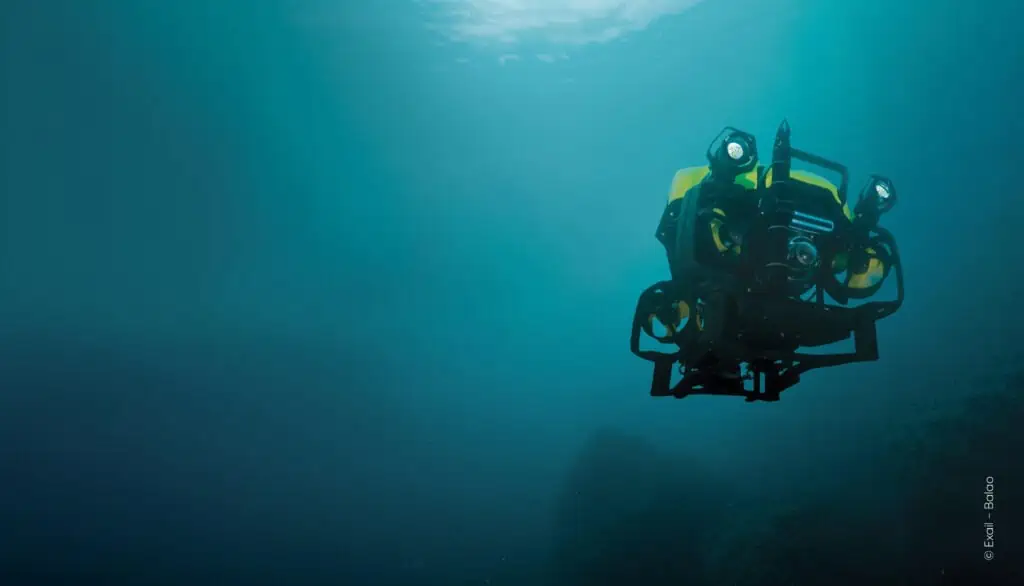
Transforming Underwater Operations with Exail’s R7 Compact ROV
Exail’s R7 Compact ROV integrates cutting-edge digital technologies to address the complexities of contemporary military missions.
Various organizations, including naval forces, special operations units, coast guard agencies, customs, emergency responders, and law enforcement, are in search of a compact, adaptable, and user-amiable system for their diverse operations.
The R7 is engineered to fulfill these demands. Despite its compact dimensions, it is capable of executing a multitude of tasks, including search and rescue missions, recovery of flight recorders, investigative object retrieval, diver support, unexploded ordnance (UXO) detection and neutralization, and also harbor surveillance and security.
Effortless Deployment and Operation
This state-of-the-art ROV is remarkably compact, measuring just 78 cm in length and weighing 32 kg, making it easy to transport and deploy by a two-person team.
Typically, the system comprises an electrical power unit, a 327-meter umbilical cable, the R7 ROV vehicle, and a control unit featuring navigation controls and a mobile console that displays real-time data from the ROV and its sensors.
To achieve its remarkable versatility, Exail designed the R7 as a robust yet lightweight platform, featuring a digital architecture that allows for seamless integration of high-performance sensors and various equipment tailored to specific mission requirements.
To ensure optimal data collection in challenging environments, the R7 boasts an remarkable power-to-weight ratio and agility, facilitated by four vectored horizontal thrusters and three vertical thrusters. This design enables it to carry substantial payloads and maintain operational capability even in strong currents.
Extensive Equipment for Enhanced Functionality
A standout feature of the R7 is its comprehensive suite of equipment. It comes standard with high-definition cameras and a powerful 4x zoom, delivering exceptional image quality even in low-light conditions.
The optical sensors are equipped with real-time image enhancement capabilities to counteract water turbidity, providing operators with remarkably clear visuals. These advanced optronic sensors are further supported by two 5,000-Lumen LED lights, ensuring optimal illumination in all scenarios.
In underwater settings with limited visibility, sonar technology remains a critical tool. The R7 can be outfitted with imaging sonars, navigation sonars, and side-scan sonars. recently, Exail has successfully integrated a Doppler Velocity Log (DVL) to enhance the precision of ROV movements.
Additionally, the R7 can be fitted with a multifunctional arm for object manipulation. The digital architecture allows for future upgrades, ensuring the ROV can adapt to the evolving needs of operators for years to come.
User-Friendly Interface for Seamless Operations
A key advantage of the R7 is its intuitive Human-Machine Interface (HMI). Data from the ROV and its sensors are displayed on two 15-inch touchscreens that remain highly legible even in radiant sunlight, while a multifunction joystick facilitates vehicle navigation.
Reliable Performance in Challenging Conditions
Operating Exail’s R7 is straightforward, whether from a land-based location or a small vessel.Once deployed, the operator activates the seven thrusters, sensors, and lights.The ROV then embarks on its mission, transmitting data in real-time to the operator. It can cover extensive search areas and operate at depths exceeding 300 meters,even in strong currents,ensuring mission success.
“Our tests have demonstrated that the R7 is inherently agile, fast, durable, and remarkably stable across all axes,” stated Philippe Roumegue, Sales Director at Exail. “It can navigate through tight spaces to enter wrecks or position itself nose-up for hull inspections. Few ROVs can match this level of performance today.”
This exceptional capability is achieved through the integration of advanced motors with a complex Attitude and Heading Reference system (AHRS), enhancing the ROV’s stability and control over its pitch and roll.
“The digital architecture of this next-generation ROV accounts for its remarkable versatility. This design allows us to create a drone that meets all our clients’ needs. Simply select from a wide range of equipment and sensors, connect them, and initiate the mission. It’s that straightforward,” Roumegue assured.