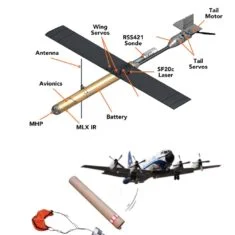


Black Swift Technologies (BST), known for its innovative scientific aerial platforms, has secured a contract with NASA to create an unmanned aircraft system (UAS) aimed at conducting upper atmospheric studies of Venus.
The proposed aerial vehicle will utilize dynamic soaring, a technique that harnesses energy from atmospheric shear. This method has been instrumental in enabling the fastest small aircraft and allows birds to sustain long flights over oceans.
“Numerous systems have been suggested for upper atmospheric exploration of Venus,yet the planet’s extreme wind conditions present a considerable engineering challenge,” states Jack Elston,Ph.D., CEO of Black Swift Technologies. “Our design will not only withstand these harsh winds but will also facilitate targeted atmospheric sampling while continuously harvesting energy, even in the planet’s shadowed regions.”
Venus boasts the highest surface temperature in the Solar System at 467°C. However, at altitudes between 50 km and 65 km, the atmospheric pressure and temperature closely resemble those found on Earth, making this region the most Earth-like environment in the Solar System, even more so than Mars’ surface. This similarity has made Venus’s upper atmosphere a focal point for exploration for many years.
The composition of Venus’s atmosphere is predominantly carbon dioxide and nitrogen, characterized by its density and heat, which far exceed those of Earth. A striking feature of the upper atmosphere is its super-rotation, where the atmosphere completes a full rotation around the planet in just four Earth days. This results in wind speeds reaching up to 100 m/s (360 km/h or 220 mph). Conversely,as one approaches the surface,wind speeds diminish significantly,with surface breezes barely reaching 2.8 m/s (10 km/h).
“Black Swift Technologies has a history of providing aerial solutions for extreme natural events such as wildfires,volcanic eruptions,tornadoes,and hurricanes,” Elston remarks.“This mission represents a logical progression of our expertise, as we now turn our attention to the extreme conditions present on Venus.”