

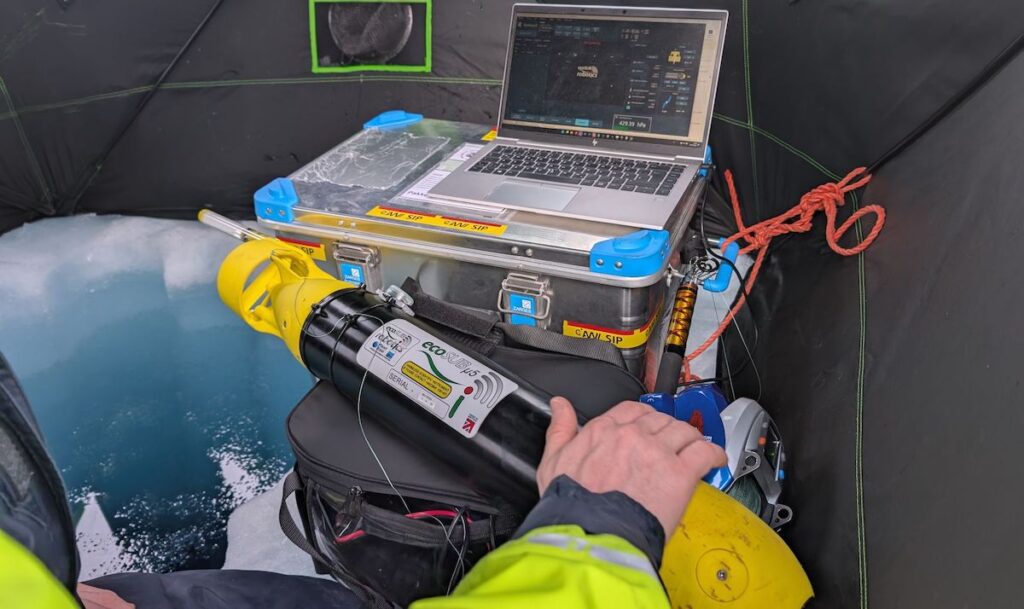
Image Credit: Alfred Wegener Institute
ecoSUB Robotics, a prominent innovator in autonomous underwater vehicle (AUV) technology, has announced the accomplished completion of an under-ice mission by its ecoSUB-µ5 Micro AUV, conducted in collaboration wiht Germany’s Alfred Wegener institute (AWI).
After navigating through several critical minutes beneath the Arctic ice,the AUV was successfully retrieved,having gathered valuable upward-looking sonar data with the help of an Impact Subsea ISS360,along with additional light measurements.
Overview of ecoSUB Robotics AUV
Engineered for optimal performance in remote and challenging conditions, ecoSUB AUVs are designed to be compact, lightweight, and easily transportable by a single operator. Their fully autonomous functionality requires minimal logistical support and can be operated from a distance using just a laptop.
The system operates independently of internet connectivity, allowing mission control from nearly any location.Local communication is facilitated through integrated Wi-Fi and acoustic modems.
ecoSUB vehicles are designed with modularity at their core. Each unit includes a customizable nosecone and payload bay that can accommodate a variety of commercial-off-the-shelf (COTS) and specialized sensors.
these sensors can range from 4K video cameras and imaging sonars to high-precision navigation systems and environmental monitoring tools. Power is provided by easily replaceable hot-swappable alkaline or rechargeable NiMH batteries, which can be changed in the field without hassle.
This achievement represents a pivotal advancement in the use of ocean robots for under-ice exploration. The initiative received backing from the Helmholtz Association’s MUSE infrastructure fund and the Microshift initiative.
As development progresses, this successful mission highlights the promising potential for autonomous under-ice exploration using ecoSUB AUVs.