

Cambridge Pixel has introduced an innovative software radar tracker tailored for manufacturers adn integrators of E-scan (electronic scan) radar systems. Unlike traditional radars that rely on mechanically rotating antennas, E-scan radars utilize electronic steering, which minimizes both the radar cross-section and infrared signature. This advancement enhances the ergonomics and durability of installations, making them ideal for ground-based security surveillance and air defense applications.
The newly launched SPx Tracker-3D serves as a primary/IFF (Identification Friend or Foe) radar tracker, featuring automatic track initiation. It processes plots from the sensor rather than video feeds to establish and maintain tracking, with outputs available in ASTERIX format for external display or fusion processing. Capable of monitoring up to 4,000 targets, the software allows users to adjust target dynamics and altitudes, effectively linking new plots to existing tracks. This ensures precise position updates through a Kalman filter,which accounts for measurement noise and potential target maneuvers,thus accommodating various uncertainties in the tracking process.If new plots cannot be linked to current tracks, they are considered candidates for new tracks, which can be promoted after a confidence-building period.
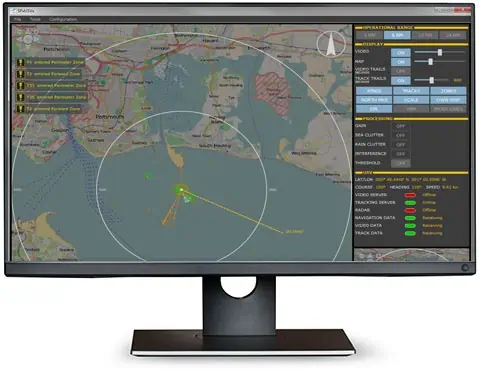
Compatible with Windows 10 (or later) and linux, the SPx Tracker-3D features a browser-based interface for initial setup and reads terrain data upon startup to define the 3D environment around the sensor. This capability helps assess the likelihood of target loss due to terrain interference. Operators can manipulate the viewpoint in real-time to inspect targets, benefiting from visualizations of plots, tracks, terrain, and related configuration data.
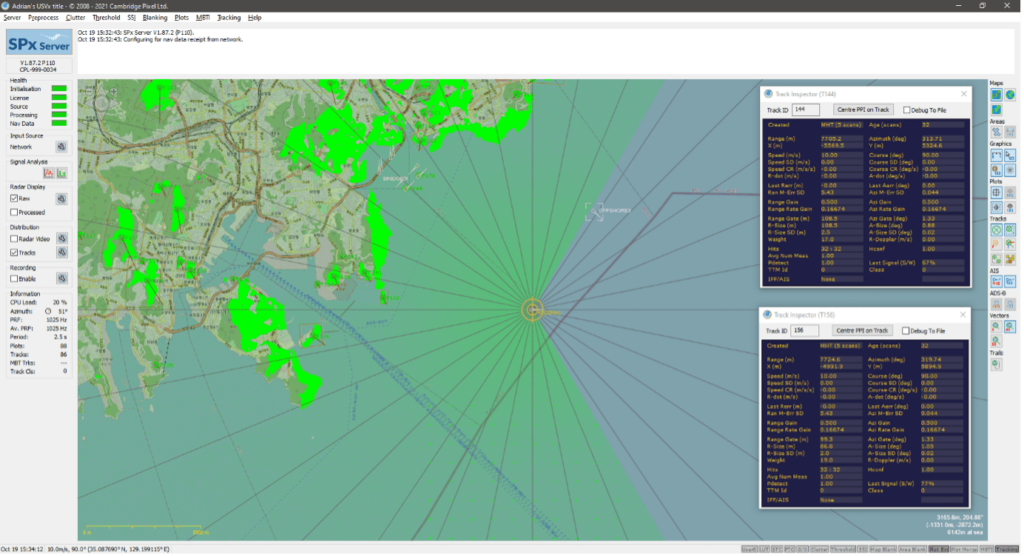
Building on the foundational techniques developed for Cambridge Pixel’s SPx Server—widely utilized in various global applications such as offshore wind farm protection, coastal surveillance, border security, firing range monitoring, and numerous air defense and naval projects that employ conventional 2D radars—the SPx Tracker-3D is specifically engineered to work with 3D data.
David Johnson, Managing Director of Cambridge Pixel, remarked, “This new offering broadens our portfolio of target tracking solutions, catering to the latest advancements in 3D and electronically-scanned radar technologies.”
Richard Warren, Technical Director at Cambridge Pixel, added, “As airborne targets become smaller and more agile, leveraging advanced tracking software is crucial for maintaining operational superiority in air defense. This 3D tracker processes plot detections at variable update rates, providing detailed information on critical targets, including position, size, height, and other radar-derived statistics, thereby enhancing air defense capabilities. Our software is highly adaptable and compatible with a diverse range of commercial and military radars, empowering our clients to deliver effective security solutions in the face of rising threats such as terrorism, smuggling, piracy, and insurgency.”