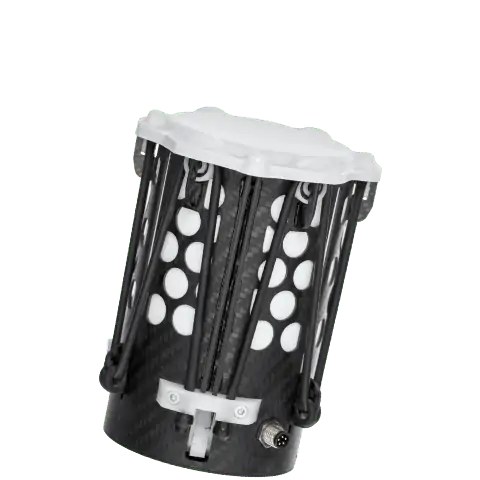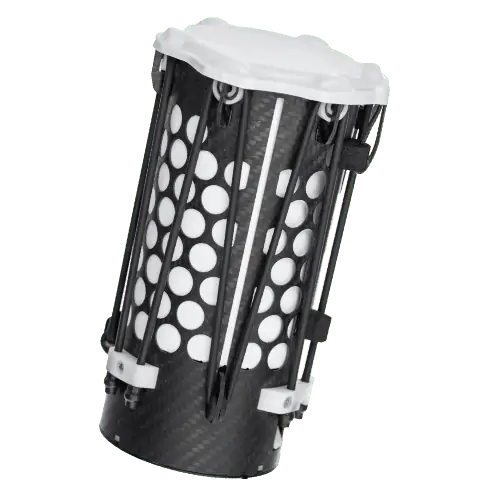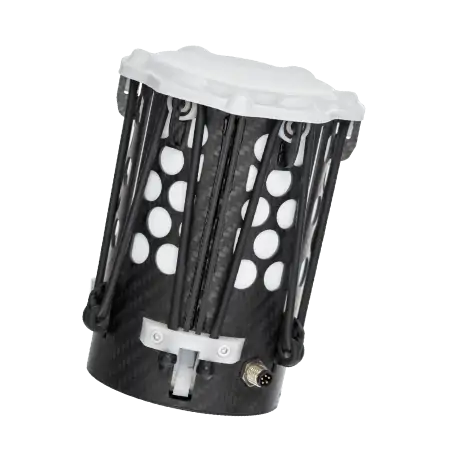

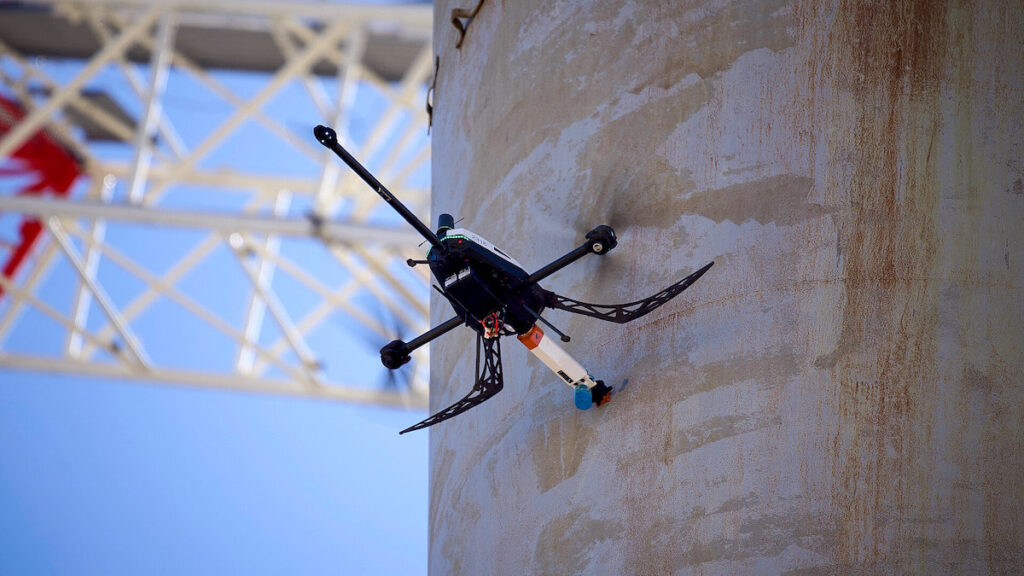
Engineered for detailed inspections near structures, Voliro’s innovative Voliro T drones considerably improve non-destructive testing (NDT) by collecting complete data swiftly, allowing for asset evaluations during operation to minimize downtime and avoid production interruptions.
NDT encompasses a variety of techniques aimed at examining materials, components, and assets without compromising their structural integrity. These methods are crucial for quality control and material assessment across multiple sectors.
Regular inspections of industrial assets, such as oil storage tanks, wind turbine lightning protection systems, pipelines, and support pylons, are essential for maintenance and compliance wiht regulations. NDT plays a vital role in identifying defects, irregularities, or signs of deterioration, ensuring the safety and longevity of these structures.
Non-destructive testing is unique in its ability to provide detailed insights into the material properties of an asset while maintaining its condition. Common NDT techniques utilize sound waves, acoustic signals, or gamma radiation to evaluate materials. By integrating various methods, NDT professionals can uncover minute cracks, voids, or welding inconsistencies that are not detectable by the naked eye.
With its 360-degree maneuverability, Voliro drones empower teams to conduct inspections safely at elevated heights and in confined spaces.The inclusion of AI-driven autonomy and three days of pilot training with each subscription makes operating a Voliro drone user-friendly.
Comparing Destructive and Non-Destructive Testing
While both destructive and non-destructive testing evaluate material strength,they function on contrasting principles. NDT focuses on preserving the material’s integrity, whereas destructive testing (DT) exposes materials to extreme conditions, such as high temperatures or heavy loads, untill they fail. Destructive tests reveal the breaking point of materials, while NDT offers critical details regarding the condition, quality, and reliability of assets.
The frequency of NDT inspections is steadfast by the type of assets in use, as outlined by regulatory agencies and certification bodies like SAFed, IoP, or ASNT. Even when NDT is not mandated, conducting regular inspections is often more economical than complete equipment replacement. Asset owners typically establish NDT schedules based on the risk associated with their assets and industry standards to prevent unexpected downtimes.
visual Testing (VT)
Visual testing (VT) entails examining the surface of a test object for any signs of discontinuities or damage. Remote visual inspections are notably effective in identifying corrosion, physical damage, misalignment, and cracks, especially in hard-to-access locations.
NDT professionals often employ VT as a standalone technique to detect visible damage, such as poor welds in oil pipelines or cracks in storage tanks. Utilizing tools like the Voliro drone,technicians can inspect 8-10 storage tanks in a single day for signs of deterioration,employing UT and EMAT payloads.
VT also serves as a preliminary step for other NDT methods, such as ultrasonic and radiographic inspections. It helps pinpoint areas of interest and ensures that surfaces are free from contaminants, coatings, or obstacles that could interfere with subsequent evaluations.
Voliro T conducting an external tank inspection.
Ultrasonic Testing (UT)
Ultrasonic testing (UT) employs high-frequency sound waves to assess assets. When a sound wave encounters an irregularity, part of the wave reflects back, indicating a potential defect. This method is similar to sonar used for locating fish but is focused on identifying flaws within materials.
UT utilizes various types of sound waves, including compression waves (which vibrate in the same direction as the sound) and shear waves (which vibrate perpendicular to the sound). Compression waves are effective for detecting parallel surface cracks or fractures, and also voids or porosity in materials. Shear waves are typically used to identify laminations or delaminations (separation of material layers) and inclusions or foreign materials within the asset.
UT is instrumental in identifying welding issues in structures, pipelines, pressure vessels, and tanks, as well as corrosion, erosion, and wall thickness concerns in piping systems. It is frequently used to detect early signs of wall thinning, pitting, or stress corrosion cracking in pressure vessels and storage tanks.
Ultrasonic testing is generally performed with handheld transducers or probes, which can also be mounted on drones to access tight spaces or elevated areas. Utilizing drones for UT inspections mitigates risks and eliminates the need for personnel to reach high or challenging locations.
Voliro has engineered specialized ultrasonic transducer payloads capable of live scanning at temperatures up to 260°C (500°F), significantly reducing the time and effort required for data collection.
Voliro drones excel in conducting thorough inspections in challenging environments such as chimneys, storage tanks, or stacks. UT inspections can often be completed in a single day without necessitating operational shutdowns.
Voliro T performing high-temperature UT inspection.
Eddy Current Testing
Eddy current testing is an electromagnetic inspection technique for conductive materials, including metals, alloys, and conductive coatings.Unlike magnetic particle testing (MPT) and liquid penetrant testing (PT), it does not require direct contact with the surface.
This method applies an alternating current to create a magnetic field, inducing eddy currents within the material. Changes in the current’s pattern indicate flaws or defects, enabling precise detection and analysis.
Eddy current testing is a reliable and cost-effective solution for quality assurance and safety inspections of power cables, heat exchanger coils, condenser tubes, non-pyrogenic alloys, and carbon fiber composites. It is indeed the preferred non-contact method for inspecting conductive materials.
Voliro is set to launch a new Pulsed Eddy current (PEC) payload capable of detecting early-stage corrosion under insulation (CUI) with insulation thicknesses of up to 100 mm.
Additional NDT Techniques
NDT employs a diverse array of techniques to evaluate materials, components, and large structures. Other key methods include:
- Magnetic Particle Testing (MPT)
- Magnetic Flux Leakage Testing (MFL)
- Liquid Penetrant Testing (PT)
- Radiographic Testing (RT)
- Acoustic Emission Testing
- ground Penetrating Radar (GPR)
- Guided Wave Testing
- Thermal/Infrared Testing (IR)
- Microwave Testing (MW)
- Laser Testing (LM)
- Leak Testing (LT)
Read the original article >>