

Launch of Cutting-Edge Autonomous navigation System at MARIN
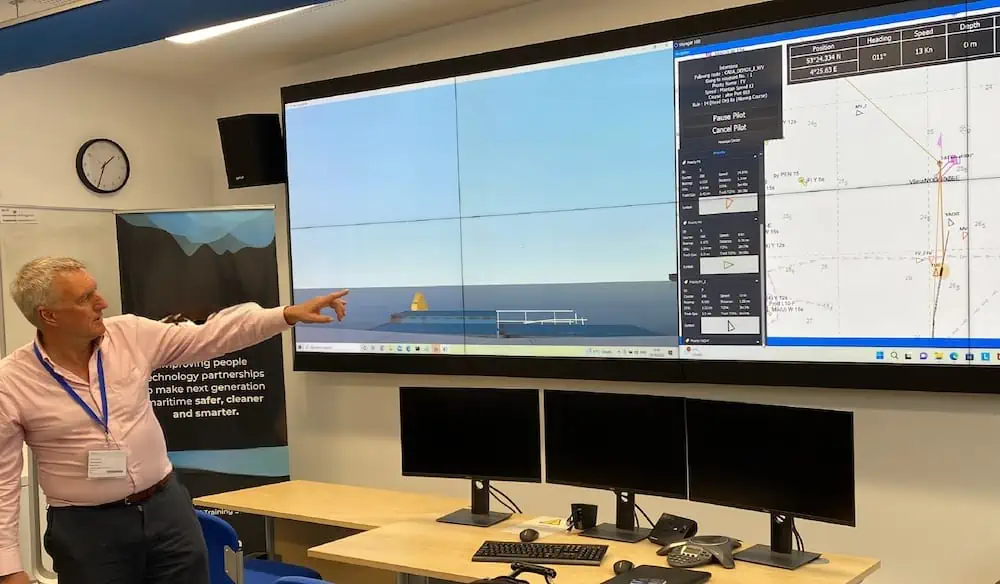
The renowned Maritime Research Institute Netherlands (MARIN) has officially implemented Robosys Automation’s state-of-the-art Voyager AI autonomous navigation software.
Innovative Features of Voyager AI
The distinctive capabilities of Robosys’ voyager AI, which infuse intelligent decision-making into maritime navigation, were pivotal in MARIN’s decision to integrate this solution with its proprietary Dolphin Simulation software.
Prosperous Trials and Collaborations
MARIN previously conducted successful trials of the Voyager 100 within its Ship Simulator, as part of the Netherlands Joint Industries Project. This initiative reached a important milestone in 2019 with trials in the North Sea involving three vessels.
One of the project’s primary goals was to assess the compliance of autonomous navigation software with the International Maritime Organization’s (IMO) Collision Regulations (COLREGS), benchmarking various candidate systems against Robosys’ Voyager 100.
In 2020, MARIN and Robosys announced a partnership aimed at refining the testing of autonomous navigation systems, utilizing the Voyager 100 as a reference point. MARIN is in the process of developing a testbed to evaluate the safety and COLREGs compliance of Obstacle Avoidance Systems.
Advancements in Voyager AI
Following extensive simulated and real-world testing across locations such as India, Canada, and australia, robosys has unveiled the latest iteration of Voyager AI, which boasts numerous enhancements.
Dimitri van heel, senior Project Manager at MARIN, expressed enthusiasm about the improvements in the new version, stating, “The Voyager 100 performed admirably in our simulator during the 2019 tests, and we are eager to assess the advancements in the latest release.”
Enhanced Collision Avoidance and performance
The upgraded system features superior collision avoidance capabilities and a unique twinning mechanism that aligns with vessel operational characteristics and mission profiles. The new collision avoidance algorithms were developed through rigorous simulation and real-time scenario testing.
Additionally, multi-vessel avoidance maneuvers have been refined, with Voyager AI now offering enhanced compliance with COLREGs, making it easier to understand and implement.
Optimized Algorithms for Greater Efficiency
Thanks to advancements in CPU technology, Voyager AI’s core algorithms have been optimized for faster performance compared to the Voyager 100, enabling improved autonomy even in high-speed and complex maritime environments.
Moreover, the Loss of Communications (LoC) feature is now available as a licensed option, ensuring operational continuity in case of dialog failures.
Customizable Navigational Paths
The system now allows for dynamic navigational path adjustments based on a vessel’s specific maneuverability and performance traits, resulting in tailored maneuvering paths. Navigational routes can be set and validated according to user-defined chart parameters, allowing for fast adjustments based on the vessel’s operating environment, whether it be oceanic, coastal, or inland waters.
Integrated Monitoring and Control Systems
A notable enhancement in Voyager AI is the integration of a Remote & Autonomous Platform Alarm, Monitoring & Control System (AMCS), designed by Robosys to support both uncrewed and minimally crewed vessels.
Voyager AI now seamlessly integrates and manages various ship hardware, including systems, switches, relays, and alarms. This includes everything from deck and hull sensors to automated responses for fire suppression systems based on pre-set parameters.
Seamless Integration for Enhanced Operations
Central to the platform’s integration is the synchronization of payload control with vessel control systems. Voyager’s AMCS now effectively combines payload management with vessel performance, ensuring optimal operations for Uncrewed Surface Vessels (USVs) tailored to specific missions.
Commitment to Innovation and sustainability
Nigel Lee, Chief Strategy Officer, remarked, “We cherish our long-standing partnership with MARIN and take pride in the ongoing evolution of Robosys’ Voyager AI.MARIN’s commitment to a smart, safe, and sustainable blue economy aligns perfectly with our vision.”
Discover suppliers of autonomous navigation technology>>