

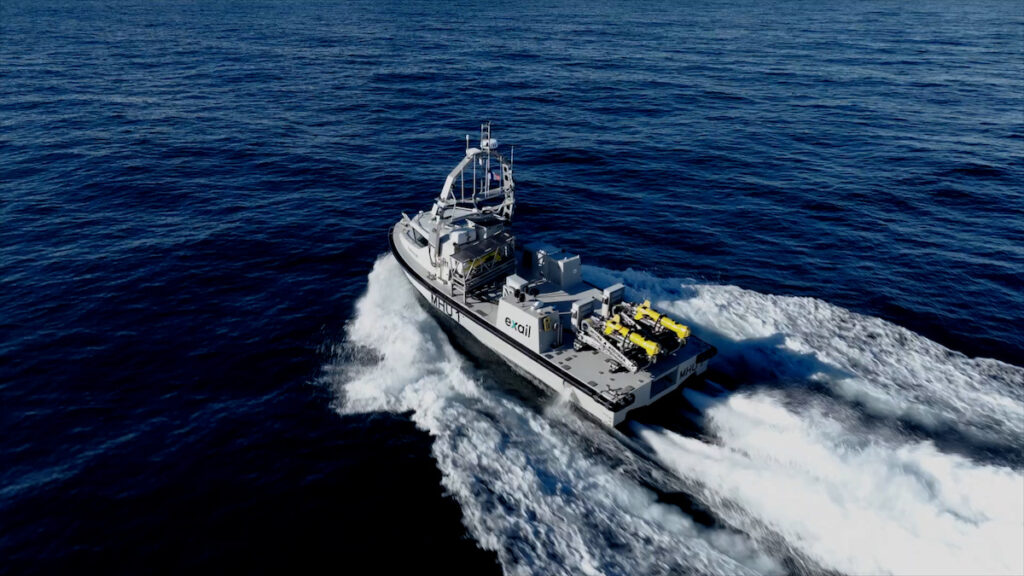
Trials of the Inspector 125 USV and mine Identification and Disposal Systems / October 2024 / Photo credit: balao
The rMCM (replacement Mine Countermeasures) initiative marks a significant evolution in the naval mine warfare capabilities of the Belgian and Royal Netherlands Navies.
Launched in 2019, the Belgium Naval & Robotics consortium—comprising Naval Group and Exail—has been commissioned to provide 12 Mine Countermeasure (MCM) vessels, around 100 cutting-edge drones, and Command and Control (C2) units.
The primary aim of this program is to enhance operational safety and efficiency through the integration of advanced unmanned technologies.
By 2024, the initiative has reached significant milestones, including the completion of the first two tool sets, triumphant launches and tests of the initial series of unmanned surface vehicles (USVs), ongoing evaluations of various underwater drones, and the initiation of crew training for the first Belgian MCM vessel.
These advancements indicate ample progress toward the program’s full operational capability, expected by 2025.
Revolutionizing Mine Clearance with Unmanned Technologies
The rMCM contract introduces a groundbreaking stand-off approach to mine warfare,utilizing advanced robotic systems to protect naval personnel in perilous environments. Each MCM vessel operates as a mothership, outfitted with the UMIS (Unmanned Mine Countermeasures Integrated System), a comprehensive array of unmanned tools, along with sophisticated software.
This system facilitates a variety of mine clearance operations, employing both autonomous and remotely operated vehicles, as well as towed systems like sonar and sweeping technologies.
At the core of this system is UMISOFT, a powerful software platform that oversees all operational aspects—from mission planning and monitoring to drone management, data analysis, and processing. UMISOFT ensures seamless integration across all mission phases, promoting effective coordination among multiple unmanned systems.
The Role of Inspector 125 USVs
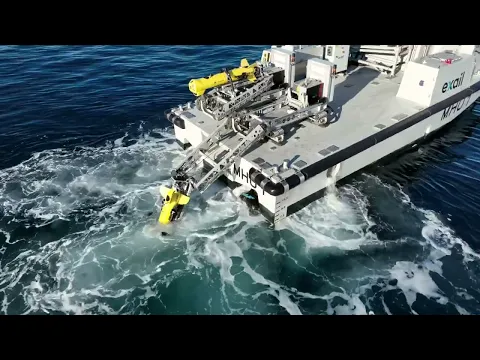
A key highlight of the program is the Inspector 125, a versatile USV essential for the deployment and recovery of drones involved in mine clearance.In 2024, the first two units of this series underwent rigorous testing in southern France and Ostend during the summer and fall.
These evaluations are validating the USV’s performance in challenging maritime conditions across various configurations, including the launch and recovery of the A18-M autonomous underwater vehicle (AUV) and the Seascan and K-Ster drones.
Enhancing Detection and classification with AUVs and Towed Sonar
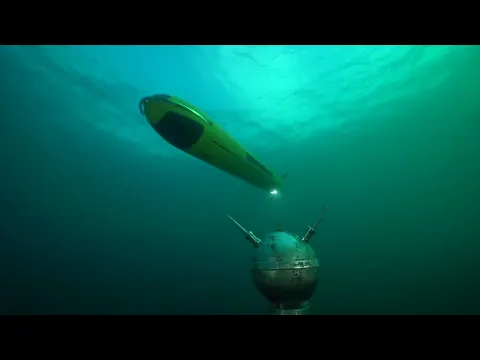
Ongoing tests for the T18-M towed sonar and the A18-M AUV, both equipped with UMISAS, Exail’s advanced interferometric synthetic aperture sonar (SAS), are underway.
These systems are engineered to detect, classify, and map underwater mines with high accuracy. Trials conducted throughout 2024 have demonstrated their effectiveness in complex environments, thereby improving the safety and reliability of mine clearance operations.
T18-M towed sonar featuring UMISAS sonar for mine detection and classification
Testing Mine Identification and Disposal Systems
The Seascan and K-Ster, crucial elements of the Mine Identification and Disposal System (MIDS), are currently undergoing trials in the Mediterranean, with additional tests planned in Ostend.
Seascan delivers high-resolution imaging through advanced cameras and electronic scanning sonar, while K-Ster provides effective mine neutralization capabilities. As testing progresses,these systems are demonstrating their ability to rapidly mitigate mine threats,ensuring safer waters for naval operations.
Training the next Generation of MCM Operators
In September 2024, the first crew training sessions for the Belgian Navy commenced at the Exail academy, situated at the newly established facility in Ostend, Belgium, where the drones are manufactured.
This training program incorporates both simulated and real-world scenarios, emphasizing the UMISOFT software suite, the C2 container, and practical MIDS training. The goal is to fully equip crews to operate these advanced systems by the end of 2024, ahead of the complete system rollout.
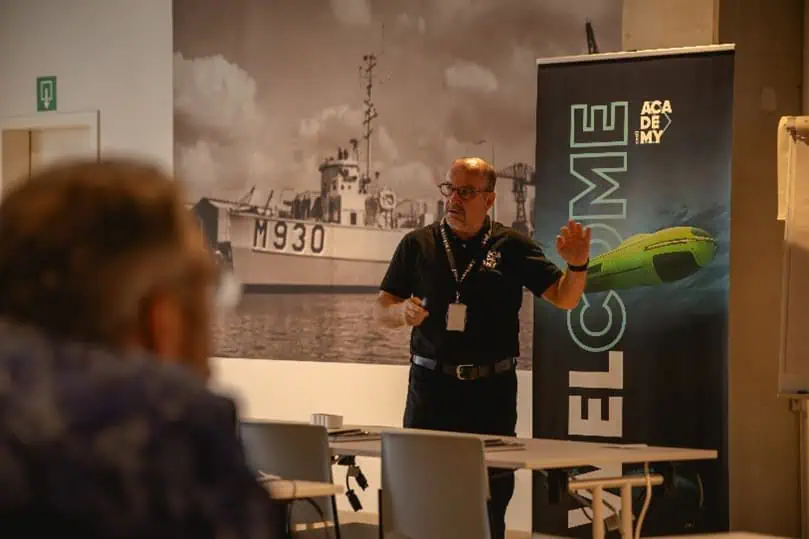
Training of the first Belgian crew at Exail Academy in Ostend, Belgium
Future Outlook: Key Milestones and Delivery schedules
With adaptable deployment options from motherships, shore facilities, or opportunistic vessels, the Belgian and Dutch navies are poised to acquire some of the most sophisticated MCM capabilities in the world.
The initial delivery of drones and essential C2 units is scheduled for the third quarter of 2025. A comprehensive qualification process,involving both independent and vessel-integrated testing,will ensure that the systems are fully operational by mid-2025.
Establishing a New Standard in Modern Mine Warfare
the rMCM initiative is swiftly reaching critical milestones, with Exail’s unmanned systems leading the charge in mine warfare innovation.As testing continues and deliveries align with the projected timeline, the Belgian and Dutch navies will soon benefit from state-of-the-art mine countermeasure capabilities characterized by improved safety, efficiency, and robotic advancements.
Read the original article >>