

To equip partners and stakeholders with essential insights, Vertiq conducts extensive thrust testing on its drone propulsion systems, utilizing a variety of third-party propellers.
The initial phase involves selecting the appropriate propeller sizes for testing and publication tailored to each motor module. By analyzing past testing data, vertiq has created an internal simulation program that predicts propeller performance across different supply voltages, optimizing the testing process.
Propellers that are excessively large for a module will hit the designated continuous torque threshold at lower speeds and voltages. In contrast,smaller propellers may reach the maximum voltage and speed without generating adequate thrust or nearing the continuous torque limit.
Setting Up the Testing Environment
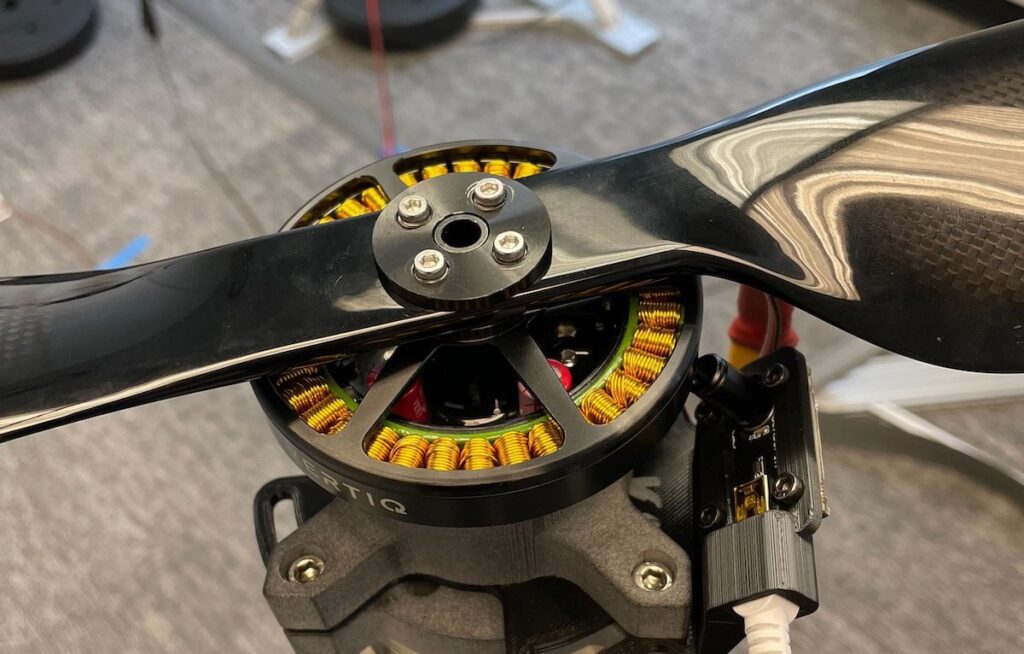
Once the suitable range of propeller sizes is identified for a specific motor module, Vertiq prepares the testing setup using its proprietary thrust test stand. The motor and electronic speed controller (ESC) are securely mounted onto an ATI Mini85 Force/Torque (F/T) sensor.
Given the sensor’s sensitivity to temperature variations, the module is not directly attached to the sensor or any thermally conductive materials that could transfer heat from the motor/ESC to the sensor.
Instead, Vertiq employs a robust nylon mounting plate that acts as a barrier between the module and the sensor. This non-conductive material safeguards the F/T sensor from temperature fluctuations, ensuring the accuracy of the data collected.
Utilizing a non-conductive surface eliminates the need for additional heat dissipation or cooling mechanisms in the setup.
Establishing Testing Parameters
While securing the motor module to the test stand, Vertiq also installs a small infrared (IR) sensor using a custom mount designed for the specific module under evaluation. This ensures that the IR sensor is precisely aligned with one of the coils.
The temperature data gathered from the coils during testing is instrumental in refining Vertiq’s coil temperature estimation model. Although this specific temperature data is not publicly available, it offers critical insights during tests with various propellers.
Environmental factors in the testing area, such as temperature, pressure, and humidity, are meticulously monitored and documented alongside all published data. This information is integrated into a National Instruments data acquisition (DAQ) system.
After the motor module and IR sensor are correctly positioned, the frist propeller is attached using the appropriate adapters. Power supplies are then adjusted to the necessary voltage for the upcoming tests.
Typically, larger propellers require lower voltages since they reach the continuous torque limit at reduced speeds. Conversely, smaller propellers are tested at the highest recommended operating voltage to achieve maximum speed during evaluations.
Collecting and Interpreting Thrust Data
For example, during the testing of a 28-inch propeller on Vertiq’s 60-08 150Kv G2 Module, a supply voltage of 24V was utilized. In contrast, a 20-inch propeller on the same module required 48V.
In both scenarios, the module achieved its continuous torque limit of 1.05Nm, albeit at different voltage levels and speeds. There was no necessity to apply 48V during the 28-inch propeller test, as the module reached its continuous torque limit around 22V.
Test phases where the motor module exceeds its continuous torque limit are not disclosed. While these values can be reached, they are not practical for sustained use without derating the module to avoid overheating and potential damage.
Once power and interaction are established with the motor module, testing commences. Using Voltage Mode and IQUART for communication, the commanded voltage is gradually increased—typically by 1 or 2V—from 0V to the designated supply voltage. At each increment,the motor runs long enough to gather smooth and reliable data.
At the end of the test—whether at maximum commanded voltage or during derating beyond the continuous torque limit—a steady-state test is performed. This continuous segment collects the Convection Thermal Conductivity Coefficient for the specific propeller and motor module pairing.
This coefficient enhances the precision of Vertiq’s internal coil temperature estimation model, which requires adjustments for different propellers due to their unique airflow and cooling characteristics.
The coefficient, along with velocity feedforward values obtained during the voltage sweep, is incorporated into the default configuration files on IQ control Center. This pre-collected data allows users to simply select their propeller, automatically populating these or else complex values.
Findings and continuous Testing
Currently, Vertiq has published around 100 distinct propeller thrust tests for its various motor/ESC configurations on its website. As new modules are developed and introduced, this number is expected to rise. If you have a specific propeller and module combination in mind for testing, feel free to reach out to Vertiq.
Read the original article >>