

Tyto Robotics illustrates the process of connecting analog sensors to Flight Stands, showcasing practical applications that emphasize the advantages of additional sensors, along with potential challenges encountered during testing.
A thrust stand is crucial for evaluating the thrust, torque, RPM, and efficiency of your propulsion system. By integrating sensors into your testing framework, you can achieve a higher level of optimization that enhances overall performance.
In the realm of unmanned systems, gathering data from external sensors is often fraught with difficulties. To tackle these challenges, Tyto Robotics has introduced a new software feature named “Input Transformations.” This functionality enables the connection of external analog sensors to all Flight Stand models, allowing for seamless integration of sensor data with propulsion metrics.
Integrating Sensors with Flight Stands
Elevate your unmanned aerial vehicle (UAV) testing by adding external sensors to your Flight Stand configuration. This guide will demonstrate how to utilize a sound sensor to optimize propeller noise levels, which is essential for achieving quieter flight operations.
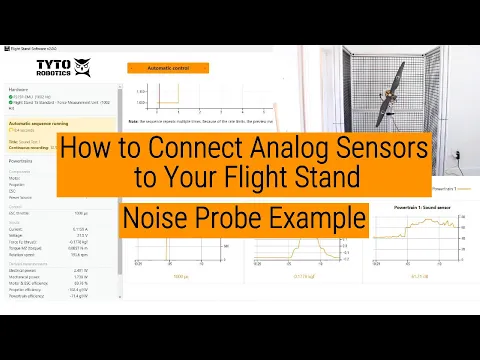
Measuring Sound Levels
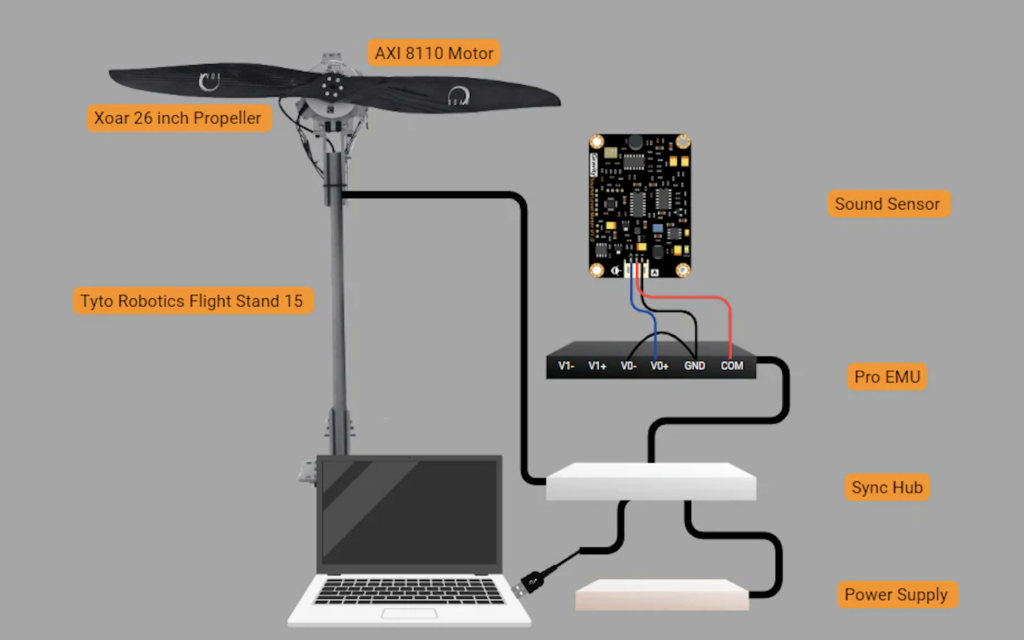
We will assess the decibel output from a propulsion system (Xoar 26-inch propeller paired with an AXI 8110 motor) using a SEN0232 sound meter connected to the Flight Stand 15 pro. This device operates on a 5V input and measures sound levels in the range of 30-130 dBA.
steps for Connection:
-
Ensure the Flight Stand is connected via USB
-
Open the Input Transformations tab
-
Create a new transformation
-
Label the sensor (e.g., “sound Sensor”)
-
Select the unit type or input “dB”
-
Assign voltage input to variable “a”
-
Enter the conversion formula (e.g., a * 50)
-
Set system limits according to specifications
-
Save the configuration
-
Go to Powertrain Mappings
-
Select “Transformations – Sound sensor”
-
Commence testing as usual
Sensor data will be included in the exported CSV files. For instance, at a throttle of 1500μs and 1099.45 RPM, the system produced a noise level of 76.18 dB.
Advantages of External sensors
Improved Performance Insights
-
Cylinder Pressure Sensors: Optimize fuel-air mixture for better efficiency
-
Thermal sensors: Prevent overheating of components
Increased Reliability
-
Humidity Sensors: Ensure consistent thrust across varying environments
-
Air Speed Sensors: Analyze flow patterns to reduce drag
Risk Reduction
-
Sound Sensors: Track noise pollution and identify mechanical issues
Addressing Testing Challenges
-
Managing Interference: Mitigate electromagnetic and vibrational disruptions
-
Data Synchronization: Integrate multiple sensor inputs effectively
-
Durability: Ensure sensors can endure harsh operational conditions
Flight Stand Innovations
-
Solid-state System: Monoblock load cell reduces vibration effects
-
Effortless Integration: High-frequency data synchronization (up to 1,000 Hz)
-
Custom Formulas: Software accommodates tailored algorithms for various sensor types
explore the complete article here, or visit the Tyto robotics website for more information.