


LPS Testing.
Voliro’s innovative drone technology significantly improves the safety, accuracy, and efficiency of Lightning Protection System (LPS) testing, playing a vital role in protecting industrial assets while optimizing inspections, minimizing operational hazards, and providing detailed data through cutting-edge solutions. Read more >>
Annually, lightning strikes the Earth over 2.1 billion times, unleashing vast amounts of electrical energy. While the majority of these strikes harmlessly dissipate into the ground, some can severely affect critical industrial infrastructure.
For example, certain wind farms in the United States experience upwards of 1,000 lightning strikes each year, with individual turbine blades facing 8 to 14 direct hits. Such frequent exposure to high voltage can lead to meaningful damage.
Importance of Lightning Protection Systems (LPS) for Industrial Safety
Lightning discharges can reach up to 300 million volts and 30,000 amps, rapidly heating the surrounding air to temperatures of 27,000°C. This immense energy makes tall industrial structures particularly vulnerable. Without adequate protection, facilities are at risk of electrical failures, fires, and structural damage. In 2023, lightning caused $76 billion in damages across North America and Europe, representing 60% of losses in wind turbine blades.
LPS serves as a crucial defense mechanism by capturing lightning currents and directing them safely into the ground. Its installation is not merely a best practice; it is often a legal requirement enforced by government agencies, regulatory bodies, and insurance companies.
Advancements in LPS Testing Through Technology
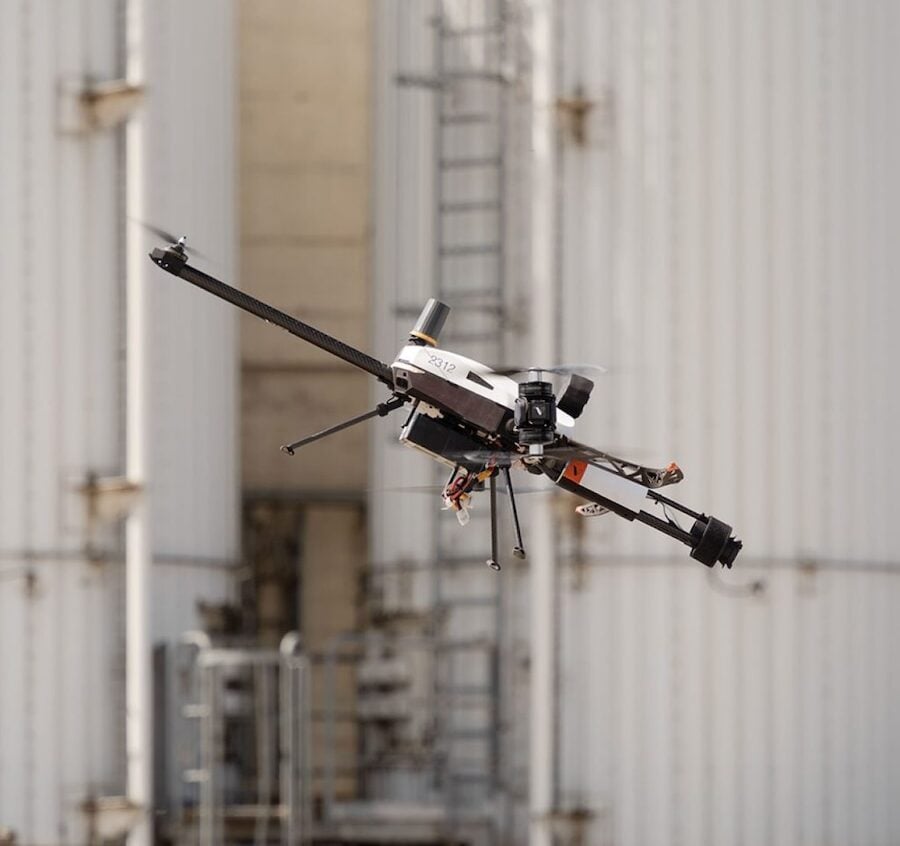
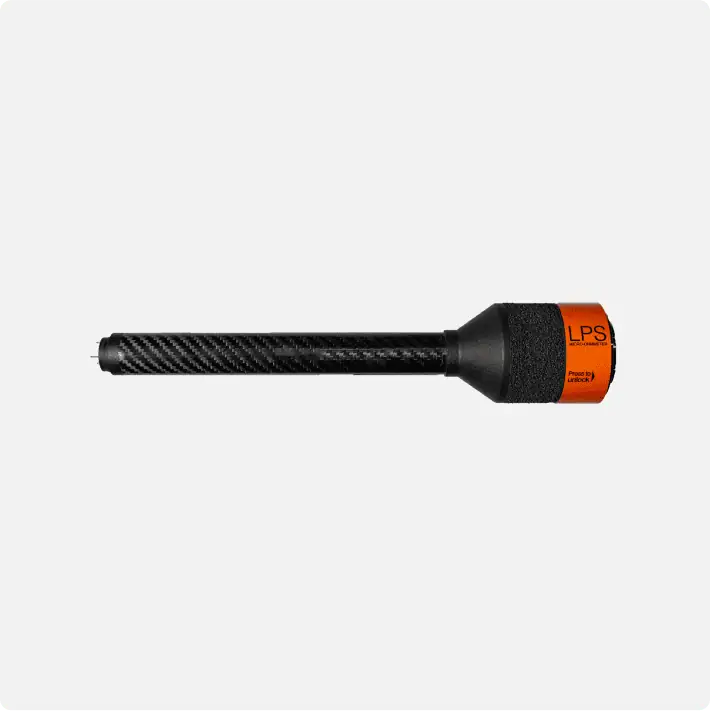
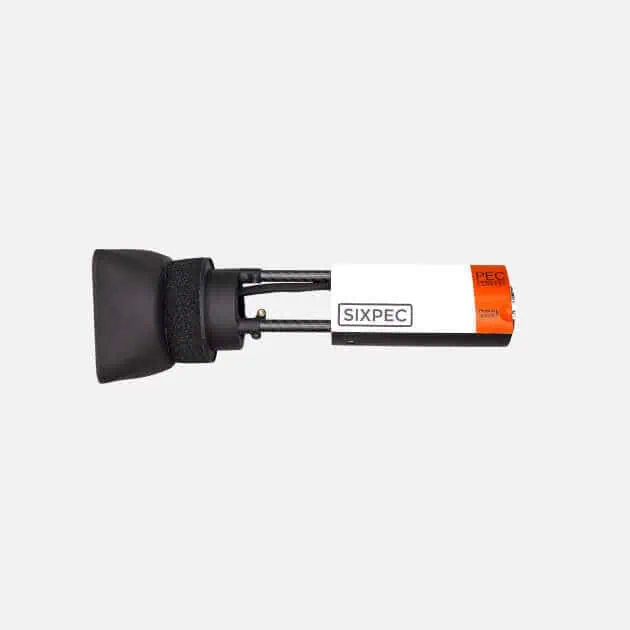
The use of drones like the Voliro T enhances both safety and efficiency. These drones, equipped with specialized LPS probes, can conduct continuity, ground resistance, and component inspections quickly and safely, even at heights of up to 250 meters.
Benefits of voliro T for Wind Turbine LPS Inspections:
- Inspection speed is 10 times faster than customary methods (90% time reduction).
- inspection costs are reduced by 50% compared to conventional techniques.
- Electrical resistance measurement of the LPS (4-wire method) takes only 20–30 minutes per turbine.
- Compatible with both single and multi-rotor systems.
- inspections adhere to IEC/EN 61400-24 standards.
- Can inspect at heights of 250 meters.
- Operable by a single person without needing access to the hub or nacelle, unless bridging a spark gap in the hub is necessary.
Industrial Assets Necessitating LPS
Assets that require lightning Protection Systems (LPS) include power distribution centers, solar farms, radar installations, telecommunications towers, airport control towers, storage tanks for hazardous materials, and oil and gas facilities such as drilling rigs and pump stations. Additionally, construction sites and wind turbines also require LPS.
Neglecting to install or maintain an LPS can lead to severe damage, operational interruptions, and costly repairs. Non-compliance may also result in regulatory penalties.
Case Study:
In 2016, the Australian wind farm operator SWF2 failed to equip its turbines with LPS. A severe storm, wich produced 80,000 lightning strikes, resulted in a widespread blackout affecting over 850,000 individuals. The company faced legal repercussions, culminating in a $1 million fine in 2020.
Key Takeaway:
It is indeed essential to ensure proper LPS installation and conduct regular inspections to mitigate risks associated with system failures.
Recommended Frequency for LPS Testing
Standards such as IEC 62305, NFPA 780, and UL 96A provide guidelines for recommended inspection intervals, taking into account factors like system design, asset type, previous repairs, and environmental conditions.
-
IEC 62305 Guidelines:
- Level 1 & 2 Systems (max current 200-150 kA):
Annual visual inspections; full assessments every 2 years.
- Level 3 & 4 Systems (max current 100 kA):
Visual checks every two years; comprehensive evaluations every 4 years.
-
High-risk, flammable sites: Inspections every 6 months.
- Level 1 & 2 Systems (max current 200-150 kA):
-
NFPA 780 Recommendations:
-
Mandatory testing after installation and repairs.
-
Annual visual inspections; semi-annual in regions prone to severe weather.
-
Comprehensive inspections every 3–5 years; more frequent (1–3 years) for critical systems.
-
Earth resistance tests during extreme seasonal changes.
-
Explosive environments: Electrical tests every 17 months; surge protection devices every 7 months.
-
-
UL 96A Requirements:
-
Initial inspection post-installation.
-
Re-inspection every 5 years to maintain certification.
-
Essential LPS Testing Techniques
Regular inspections are vital for ensuring the reliability of LPS throughout the year. IEC 62305 and NFPA 780 outline several effective testing methods:
Visual Inspection
This method identifies visible wear, corrosion, and structural issues. Direct access to all system components is necessary, which can be facilitated by drones equipped with high-resolution cameras.
Continuity Testing
This confirms uninterrupted current flow through system components, typically performed using digital multimeters, specialized testers, and low-resistance ohmmeters.
Surge Protection Device (SPD) Testing
This verifies SPD performance, ensuring it can safely divert excess voltage. The process includes checking bonding integrity, circuit continuity, and peak discharge capacity.
ground Resistance Testing
This measures resistance between grounding electrodes and the earth to ensure effective current dissipation. Techniques used include soil resistivity,fall-of-potential,selective,and stakeless methods.
This guide emphasizes the necessity of consistent LPS testing and the role of modern technologies in enhancing inspection processes.