

In this piece, Ben Gross from Elsight discusses how the Halo platform addresses the challenge of drone connectivity by utilizing up to four cellular links from various network providers, ensuring optimal connection by monitoring and switching to the best available option during signal dropouts.
A key factor in the success of drone operations is the establishment of dependable communication and data links that ensure continuous connectivity and adequate bandwidth tailored to the specific mission needs.
Historically, moast commercial Unmanned Aerial Systems (UAS) have relied on unlicensed radio frequency (RF) communication links. While this method is effective for many uses, it comes with notable limitations.
RF data links necessitate a line of sight (LOS) between the drone and the ground control station. This requirement poses a challenge for long-range
BVLOS (beyond visual line of sight)
operations, which demand choice technologies to overcome this constraint. Additionally, the unlicensed RF spectrum is becoming increasingly congested due to the growing number of devices, limiting the capacity needed for widespread drone integration.
For larger UAV platforms, particularly in military applications, SATCOM (satellite communications) is often employed to address these challenges. However, SATCOM terminals tend to be too large for many smaller drones used in commercial applications like inspections and mapping. Furthermore, SATCOM services usually come with high data subscription costs that can significantly impact operational budgets.

Cellular connectivity presents a promising alternative. The modems used are compact and lightweight, minimally affecting the size, weight, and power (SWaP) constraints of the aircraft. Drones equipped with cellular technology can theoretically operate at considerable distances from their control stations, provided they remain within the coverage area of a cell tower from their selected network.
However, the transition to cellular networks for large-scale drone operations is not without its challenges.
Understanding the RF Habitat for Aerial Platforms
Cellular networks are primarily designed for ground-level users and devices, resulting in a significantly different RF environment at the altitudes where drones typically operate.
On the ground, obstacles such as buildings can obstruct the line of sight between cell towers and devices. Drones flying above these barriers may receive stronger signals from nearby towers.While this can be beneficial if the towers belong to the drone’s network, it can also lead to interference from irrelevant towers, resulting in a low signal-to-interference-plus-noise ratio (SINR) that can hinder the reception of critical commands.
Another notable factor influencing the RF environment for drones is the radiation pattern of cellular antennas. Most cellular towers use directional antennas that focus their power in a specific direction, typically downward, as most devices are ground-based.
In addition to the main lobe, directional antennas emit side lobes, which are lower-power signals radiated in less relevant directions. Drones operating at certain altitudes may often rely on these side lobe signals rather than the primary lobe.

Connectivity Issues at Higher Altitudes
Due to the nature of side lobes, the cellular connections available to drones can be more dispersed than those on the ground, where the nearest cell is typically the most suitable.Research by Ericsson indicates that this pattern becomes particularly fragmented at altitudes of 300 meters and above.
Consequently, a drone connected to a cell via a side lobe may experience a sudden drop in signal strength as it moves, potentially leading to a lost connection before it can switch to another cell.
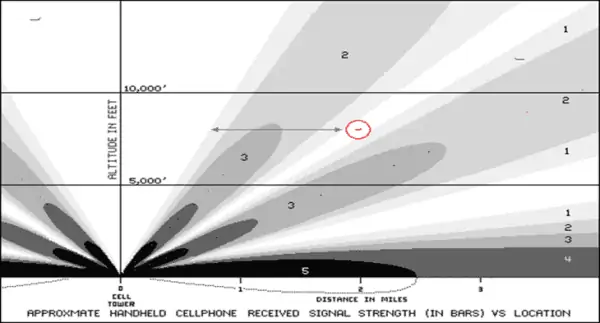
Cell Tower Lobe Emissions. Note the position of the drone (red circle) between lobes (Source: Qualcomm)
Verizon is collaborating with the Federal Aviation Administration (FAA) to explore the capabilities and limitations of its network in the U.S. for supporting UAS command and control. They are focusing on CNPC (command and non-payload communications), which involves the transmission of data necessary for aircraft control, excluding data from cameras and sensors. It is indeed likely that applications requiring high-bandwidth, such as 4K video streaming, will necessitate the advanced capabilities of 5G rather than LTE.
Strategies for Enhanced drone Connectivity
To address the challenges posed by varying radiation patterns at altitude, several strategies can be implemented. Cellular networks might incorporate features like interference detection and improved handover management tailored to UAS needs. Additionally, drone operators could utilize cellular mapping data to assess signal strength, channel capacity, and tower height, allowing for better operational planning.
To maximize the likelihood of maintaining robust connectivity during drone operations, it is advisable to adopt a specialized solution that supports multiple network providers and employs automatic link monitoring to ensure uninterrupted connection.
Elsight’s Halo platform offers a comprehensive solution, capable of utilizing up to four cellular links from different network providers. It continuously monitors all available connections and seamlessly transitions to the best option in the event of a dropout.
Halo also employs AI-driven cellular bonding to combine the bandwidth of all available connections into a single, secure link. The platform is 5G-ready and can be easily integrated into various drone systems, preparing users for next-generation applications like BVLOS.
For more information on how Halo can enhance connectivity for your LTE and 5G-enabled drones, please reach out.