

Innovative Techniques for Monitoring Ocean Currents
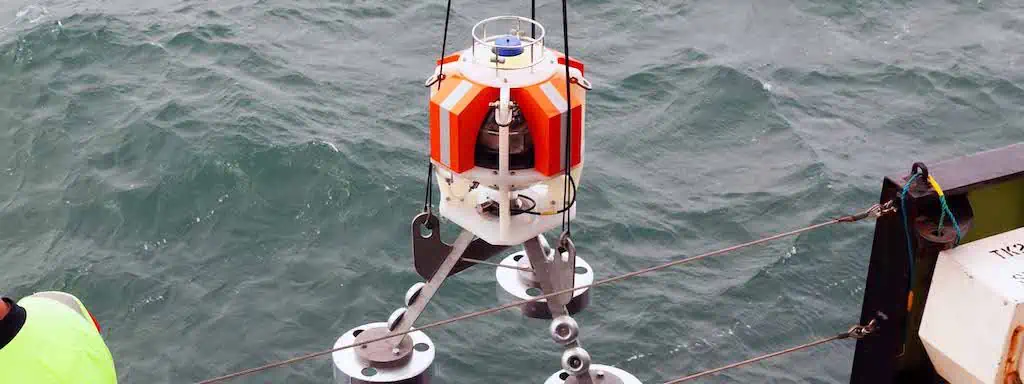
Marine researchers have deployed two FETCH AZA bottom pressure recorders (BPRs) from Sonardyne across the Atlantic Ocean to analyze the dynamics of global ocean currents that significantly influence the EarthS climate.
The Role of the Atlantic Meridional overturning Circulation (AMOC)
The Atlantic meridional Overturning Circulation (AMOC) is a critical system of ocean currents that carries warm surface waters from tropical regions northward toward the subpolar and Arctic areas. In these colder regions, the water cools, increases in density, and sinks, eventually flowing back southward at deeper levels. This extensive ‘conveyor belt’ of water plays a vital role in regulating global heat distribution,influencing regional sea levels,enhancing the ocean’s capacity to absorb carbon,and affecting weather patterns in Europe.
Deployment of BPRs for Climate Research
To assess the AMOC’s effects on climate change, the Scottish Association for Marine Science (SAMS) based in Oban has positioned two deep-sea BPRs—one in the northeast Atlantic and another in the Labrador Sea.These devices will continuously monitor variations in sea surface height.
Situated thousands of meters beneath the ocean’s surface, the BPRs will measure sea surface height with centimeter-level precision, enabling researchers to make detailed comparisons between the two sites. With a deployment period of up to ten years,this initiative will facilitate the tracking of changes in the AMOC’s speed and strength,providing essential data for climate forecasting.
Recent Deployments and Observations
The northeast Atlantic BPR was installed from the RRS James cook during the Overturning in the Subpolar North Atlantic Programme (OSNAP) research expedition, co-led by SAMS and the National Oceanography Center (NOC) in August. Meanwhile,the western BPR was deployed by SAMS oceanographer Dr. Sam Jones during a cruise aboard the RV Meteor, organized by the German marine institute GEOMAR in September.
Typically, the eastern Atlantic Ocean exhibits a sea surface height approximately 20 centimeters greater than that of the western side. However, the water flow does not simply move from east to west; instead, the Coriolis effect, resulting from the Earth’s rotation, creates a circular flow that generally moves from south to north.
Energy Transport and Climate Implications
The AMOC is responsible for transporting around 1.25 Peta (10^15) Watts of energy from tropical regions to the subpolar and Arctic areas—an amount exceeding 60 times the current global energy consumption rate. Despite its significant influence on climate, continuous measurements of the AMOC have only been conducted for 19 years, which limits our long-term understanding of its relationship with climate change.
Data Transmission and Ongoing Research
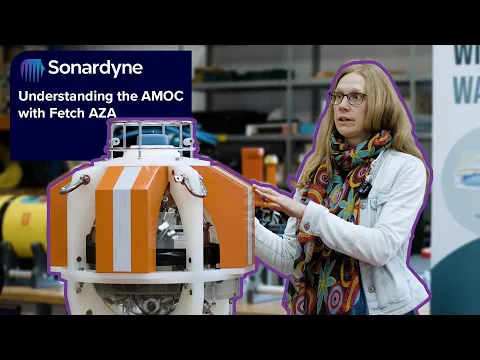
The data collected by the BPRs can be wirelessly transmitted through the water to a ship or an uncrewed platform, eliminating the need to retrieve the devices for data access. Currently, OSNAP is six months into its data collection phase, and to celebrate this milestone, Sonardyne and SAMS have released a video titled “Understanding the AMOC,” which elaborates on the impact of ocean currents on climate and the importance of the research program.
Expert Insights on the Technology
Dr. Kristin Burmeister, an oceanographer at SAMS and co-chief scientist on the OSNAP cruise, remarked, “This marks the first application of Sonardyne pressure sensors in ocean physics, and it has the potential to revolutionize our ability to measure the vast AMOC. Understanding the speed of these currents will enable us to determine the volume of water being transported and, consequently, the amount of heat being moved.”
Dr.Burmeister added, “This heat is crucial for Europe’s climate, contributing to its relatively mild weather. The AMOC’s influence on global climate is so profound that it is indeed imperative to gain a deeper understanding of its movement, velocity, and heat transfer. This information will enhance various climate models, assisting governments and societies in preparing for future climate changes.”
Technological Advancements in Oceanography
Geraint West, Head of Science at Sonardyne, stated, “The AZA technology is groundbreaking, as previous calibration requirements for pressure sensors often compromised lengthy observations, limiting their application in long-term studies. The Ambient-Zero-Ambient (AZA) method utilized in the fetch AZA allows for autonomous in-situ recalibration with a high-accuracy internal barometer, ensuring consistent accuracy for up to ten years.”
He further noted, “Developing this technique required years of investment by Sonardyne, and while it has been successfully implemented in other sectors, we are thrilled to see it now applied in physical oceanography, notably in a project that will enhance our understanding of critical climate drivers.”