

Ground Control recognizes that unmanned aerial vehicles (UAVs) are revolutionizing logistics, from detecting potential hazards on offshore energy platforms to transporting essential supplies and medications to isolated areas.Discover more >>
However, operating UAVs beyond visual line of sight (BVLOS) presents various challenges, despite the numerous logistical advantages. Communication with drones that are out of sight via radio frequencies (RF) can be unreliable due to network congestion.
In the full article, Ground Control explores the request of Low Earth Orbit (LEO) satellite communications for BVLOS operations, including their Short Burst Data (SBD) products like RockBLOCK 9603. This technology enables operators to receive data on location, altitude, and speed, and can send basic commands such as ‘return to the nearest rally point’, ‘head home’, or ‘end flight’.
Ensuring redundancy in drone communications is essential, whether for infrastructure safety or delivering critical medications.
Read the full article here,or continue below.
The Essential Function of LEO Satellites in Ensuring safe UAV Operations
Unmanned Aerial Vehicles (UAVs) are reshaping the logistics sector. Their applications range from delivering medical supplies to remote communities to monitoring offshore wind farms for potential hazards.
The cost-effectiveness of drones is evident; they are cheaper to operate than manned aircraft and enhance safety. Traditionally, drones have been deployed in hard-to-reach areas, such as remote islands, mountainous regions, or deserts, frequently enough facing challenges like adverse weather, radiation, and elevation risks. While these conditions can impact UAV performance, it is certainly preferable to risk a machine rather than a human life!
Nonetheless, operating drones comes with its own set of hurdles, notably when it comes to BVLOS piloting. Without this capability, drones must stay within the operator’s line of sight, which limits their commercial potential. To operate safely in non-segregated airspace (shared with manned aircraft), drones must be able to detect and avoid other air traffic, maintain reliable communication with all parties involved (including the remote pilot and air traffic control), adhere to relevant regulations, and respond to dynamic situations.
Currently, certification is handled on an individual basis, which can take years. Recently, satellite network provider Iridium released a white paper advocating for a Minimum Equipment List (MEL) that would expedite certification for drone operators, allowing them to operate safely in designated airspace. Meanwhile, the UK’s Civil Aviation Authority (CAA) is developing a regulatory framework aimed at enabling specific BVLOS operations in non-segregated airspace by 2026.
untill these initiatives are realized, large-scale drone operations will continue to be confined to well-defined and controlled areas, minimizing the risk of conflicts with other aircraft. As a notable example, the newly introduced European Standard Scenario (STS) allows drone operators to bypass the EASA’s risk assessment and authorization process by limiting altitude, flight paths, and operational hours. Both pilots and drones must meet specific standards, including communication failsafes: the ability to reestablish a data link if it fails or to remotely terminate the flight.
Communication Strategies for BVLOS Drone Operations
When possible, drone operators utilize airborne VHF/UHF/L-Band radio or cellular networks to communicate with their UAVs. However, these radio frequencies can face congestion, security issues, and regulatory constraints. In many cases, especially in unpopulated regions, cellular connectivity may not be feasible. Thus, ensuring connection redundancy is becoming increasingly vital for BVLOS operations.
This is where Low Earth Orbit (LEO) satellite communication becomes crucial. LEO satellites orbit closer to the Earth than their geostationary counterparts, which significantly reduces latency—the time it takes for a message to be sent to the drone and received back—from approximately two seconds to under one second.
As illustrated, while fewer satellites can cover vast areas when positioned far from the Earth, LEO satellites only cover limited portions of the surface. Thus, multiple LEO satellites are necessary for global coverage, with Iridium being the first and only globally accessible satellite IoT network. This is why UAV manufacturers frequently choose Iridium for adding failover communication capabilities to their drones.
Iridium provides various airtime options for satellite connectivity, ranging from Certus 700 (700 Kbps, sufficient for live video streaming) to Short Burst Data (SBD), which transmits 270/340 bytes per message. SBD is particularly effective as a failover connection; it allows operators to obtain data on position, altitude, and speed, and to send basic commands like ‘return to the nearest rally point’, ‘head home’, or ‘terminate flight’.
SBD is lightweight,energy-efficient,and meets most Size,Weight,and Power (SWaP) requirements for UAVs. It provides a secure and dependable connection, making drones less susceptible to hacking and ensuring safe operations within controlled areas.
With satellite IoT connectivity, notable advancements are already underway. As a notable example, our client Zipline employs SBD as a failover communication method for its autonomous aircraft, which deliver prescriptions, groceries, vaccines, and livestock supplies.
Recently, Zipline was highlighted in the peer-reviewed journal Vaccine, which noted that its aerial delivery method for vaccines to remote regions in Ghana has significantly improved health outcomes and reduced disease incidence among children.
It is estimated that Zipline’s delivery service has saved around 727 lives in the Western-North Region by providing vaccines to 15,000 children who otherwise would not have had access.
Popular YouTuber Mark Rober documented his experiance with Zipline, and it’s definitely worth watching to gain insight into this remarkable operation.
To transport essential chemotherapy medications to patients on the Isle of Wight, UK-based Skylift UAV developed an autonomous eVTOL (electric vertical take-off and landing) aircraft capable of flying for 1.5 hours on a single charge,reaching speeds of up to 100 mph. In BVLOS mode, it can cover distances of up to 100 km, depending on the payload.
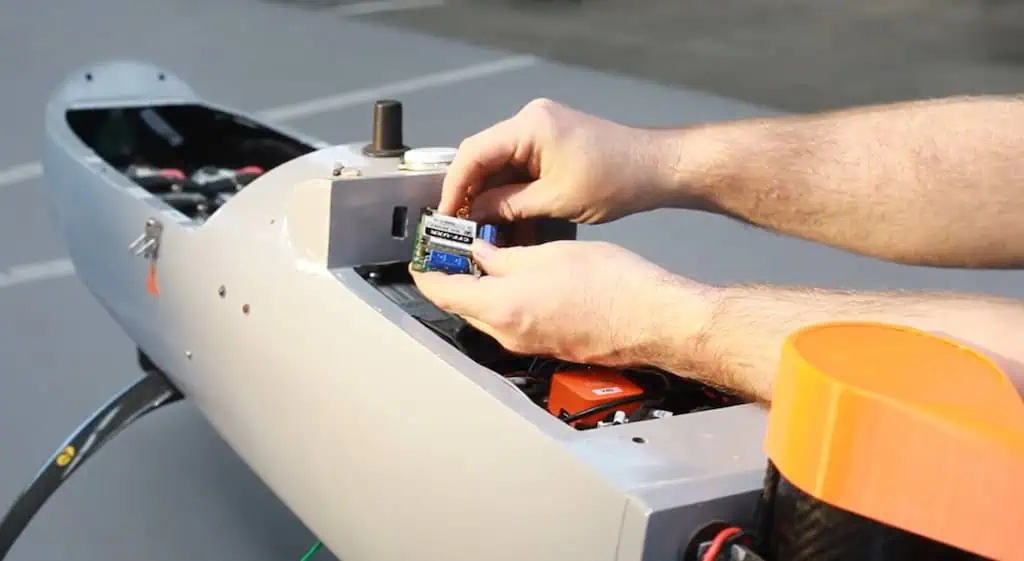
While the drones operate autonomously, they are overseen by Skylift’s safety pilots, who can take control at any moment. As the drone navigates BVLOS and across water (the Solent), it is crucial for the pilots to maintain two reliable communication channels with the drone at all times. The Skylift UAV team opted for the RockBLOCK 9603 to provide SBD connectivity alongside aviation-grade L-Band radio, ensuring connectivity nonetheless of the drone’s location.
RockBLOCK enables them to send and receive data from the aircraft and is part of the comprehensive communication system that all Skylift drones are equipped with. It serves as the final safeguard for mission success.