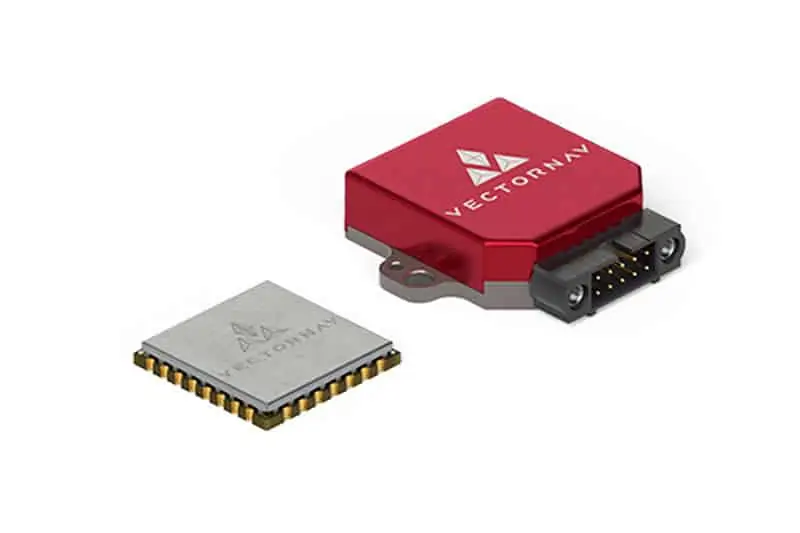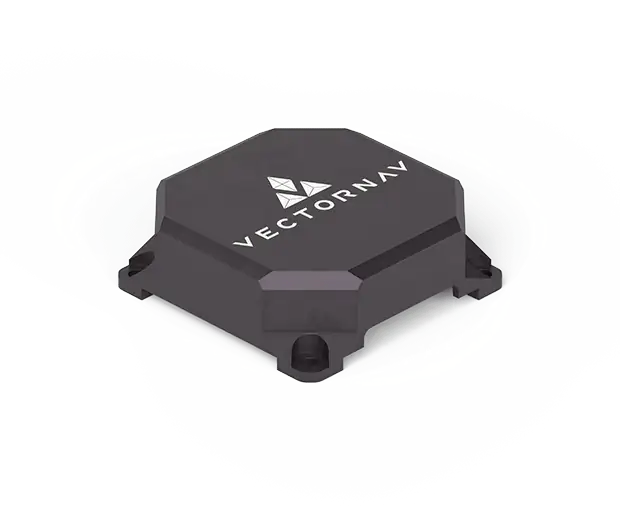
VectorNav has announced that its VN-200 GPS-aided inertial navigation system (INS) will serve as the primary navigation solution for Hydra Technologies’ latest long-endurance unmanned aerial vehicle (UAV), the S45 Balaam.
The S45 Balaam features a dual-engine, gasoline piston design with a wingspan of 5 meters, an operational range of 120 kilometers, and an remarkable endurance of 12 hours.It can reach an operational ceiling of 4500 meters and has a payload capacity of up to 5 kilograms (10 pounds). This UAV is engineered for rapid deployment, allowing a two-person crew to set up the ground control station and aircraft in under 20 minutes, making it flight-ready.
Read the complete case study >
While Hydra has cultivated the expertise to design and manufacture the airframe, control electronics, and autopilot software internally, they depend on external specialists for advanced sensors like the Inertial Navigation System (INS). Their previous INS was based on outdated technology, leading to performance and reliability challenges. “Our former INS was plagued by low accuracy, offering only 0.4° dynamic pitch and roll, with a limited measurement range of 300°/s gyros and 6 g accelerometers, a low data output frequency of 50 Hz, and subpar gyro angular walk performance,” explains Monica Rodriguez, R&D Communications Manager at Hydra Technologies. “We recognized that a modern, high-performance INS was crucial for the S45’s primary flight control system.”
The dual-engine setup of the S45 generates important vibrations, creating a demanding habitat for inertial sensors. Given that the S45 functions as an ISR platform,it was essential for the INS to deliver precise,low-latency attitude data for gimbal stabilization,ensuring a smooth video feed for operators.
To address the more stringent operational demands of certain clients, the Hydra team also needed to assess the INS’s performance during GPS outages. The ideal INS solution had to meet two key criteria: maintain accurate position and attitude estimates during temporary GPS loss and quickly regain full performance after GPS re-acquisition.
Size, weight, and power consumption (SWaP) were critical factors in selecting candidate INS solutions for evaluation. Even though the S45 has a relatively generous payload capacity of 5 kg, minimizing the weight of the INS would directly enhance the payload capabilities. After an extensive search, the Hydra team chose to evaluate two options: one from a european INS supplier and the VN-200 GPS/INS from VectorNav Technologies.
“The evaluation of the VN-200 was seamless. The straightforward interface and prompt support from the VectorNav Engineering team allowed us to integrate the VN-200 data into our autopilot swiftly, enabling us to conduct multiple flight tests under real operating conditions,” states Rodriguez. “The VN-200 delivered exceptional attitude performance, surpassing all expectations in our high-vibration environment, even outperforming larger, pricier systems. No other solution matched the SWaP requirements while providing that level of performance.”
Hydra engineers extended their testing to assess the INS’s performance during GPS loss,with the VN-200 again demonstrating superior results,yielding the lowest position error propagation compared to other sensors over the same timeframe. “The combination of the VN-200’s performance, compact size, and low power consumption made the decision clear,” Rodriguez adds.